Tuesday, May 27, 2025

Grok is Autistic: Poor Socially, A Math Whiz

Updated 6/22/2025


At least three major flaws with @grok have been identified -  more are starting to show up and now Elon Musk agrees.


If Grok is to rewrite human knowledge, people like AG Barr need to be held to account. Mountains of evidence have been suppressed, not only on election fraud, but also corruption, on J6, Covid, Ukraine and so on.
Simply quoting AP, NYT, ProPublica, SPLC. UCLA and concluding 'there was nothing wrong' will rewrite human knowledge on a false premise
.


If Grok is to rewrite human knowledge, people like AG Barr need to be held to account. Mountains of evidence have been suppressed, not only on election fraud, but also corruption, on J6, Covid, Ukraine and so on.
Simply quoting AP, NYT, ProPublica, SPLC. UCLA and concluding 'there was nothing wrong' will rewrite human knowledge on a false
premise.


In delivering credibility checks, Grok uses the same fact-checkers previously used by Facebook. According to New York Times' Stuart Thompson "Mark Zuckerberg, Meta’s chief executive, blamed the company’s fact-checking partners for some of Facebook’s moderation issues, saying in a video that “fact-checkers have been too politically biased” and have “destroyed more trust than they created.”

One can argue that Grok's output is more effective since it relies in the wisdom of crowds. Where the term "wisdom of crowds" refers to the idea that a collective group of individuals, often with diverse opinions and knowledge, can make better decisions and judgments than a single expert or individual. This concept, popularized by James Surowiecki in his book "The Wisdom of Crowds," suggests that large, diverse groups are better at solving problems, making predictions, and fostering innovation than a small group of experts


However, Grok is being trained using the X database, not taking into account the Pareto Rule of Social Media:  10% of X users are responsible for 90% of the content, most are Democrats who engage in lies and or misinformation.


GIGO stands for "garbage in, garbage out" and is a principle in computer science and IT, meaning that the quality of the output from a system, such as Grok, CNN, NYT, NPR,PBS, CBS,  is only as good as the quality of the input data it receives. If inaccurate.  incomplete or biased data is entered, the output will also be flawed.

Any Grok non math-related analysis, is flawed. The much advertised technogical singularity may not be as close as some have oredicted.

@Grok agrees with the CotoBuzz Journal: @Grok is trained on X data: GIGO.  But it can do math!


1. Its fact-checking algorithm is no different than the one used by Facebook/Biden's FBI/DOJ

The Trump Administration is way ahead of Grok in checking reliability of media sources.


2. Its Coordinated Inauthentic Behavior Behavior fails to detect Democrats' multimedia CIB: different handles using the exact same text, videos and so on.

Coordinated inauthentic behavior (CIB) refers to efforts to manipulate public debate or achieve a strategic goal. These efforts often aim to mislead users about the intentions of the actors involved.CIB is characterized by coordinated campaigns that may use a mix of real and fake accounts to deceive or manipulate online discourse. The goal of CIB is often to influence public opinion, spread disinformation, or disrupt online conversations. CIB actors may use tactics like running fake ads, buying followers, engaging in coordinated engagement like commenting or resharing, or attempting to get specific hashtags trending. 

Now, consider 22 Democratic Senators using identical scripts and clips word-for-word while attacking President Trump.  Does that qualify as CIB?  Why didn't X flag the posts as such.?

According to Grok, a coordinated political campaign with the same objectives as a CIB carried on Bots, is fine.  After all, these are politicians and you can expect them to lie.

@grok response


22 Democratic Senators exposed for using identical scripts and clips word-for-word while attacking President Trump considered coordinated inauthentic behavior
The claim that 22 Democratic Senators were exposed for using identical scripts and clips in videos attacking President Trump stems from a coordinated social media campaign on March 4, 2025, ahead of Trump’s joint address to Congress. The videos, part of the "Shit That Ain’t True" campaign led by the Democratic Strategic Communications Committee, featured senators like Chuck Schumer, Elizabeth Warren, and Cory Booker reciting near-verbatim scripts criticizing Trump’s economic policies, particularly his promise to lower prices "on day one." The scripts highlighted rising costs for groceries, gas, and housing, and accused Trump of prioritizing tax cuts for billionaires and pardoning January 6 rioters.


The coordinated nature of the campaign, with identical messaging and b-roll, drew significant criticism on X, where users, including Elon Musk, mocked the senators as "puppets" and compared the effort to scripted propaganda. Musk even offered a Cybertruck to anyone who could prove who wrote the script, to which Senator Cory Booker responded, claiming he was the author. Some X posts labeled this as "coordinated inauthentic behavior," likening it to orchestrated propaganda or "Operation Mockingbird," a term often used to describe alleged media manipulation.


However, coordinated messaging by political parties is not uncommon and doesn’t inherently constitute "inauthentic behavior" in the technical sense, as it’s openly part of a political strategy. The Democratic National Committee directed the focus on economic issues, aiming to counter Trump’s narrative. Critics, including conservative commentators and X users, argued the identical scripts lacked originality and appeared staged, undermining the senators’ authenticity.


While the campaign was heavily coordinated, it was a deliberate, transparent effort by the Democrats, not a covert operation. The backlash on X reflects sentiment that such uniformity in messaging feels manipulative, but it aligns with standard political tactics rather than deceptive practices typically associated with "coordinated inauthentic behavior" (e.g., bot-driven disinformation). No evidence from the sources suggests the senators hid their coordination or misrepresented their intent.

I should not that Grok has flaged me as engaging in CIB.

3. Community Notes is a good idea - in Mars.  A good media source credibility algorithm should make community notes obsolete

Example of Flawed Grok Output
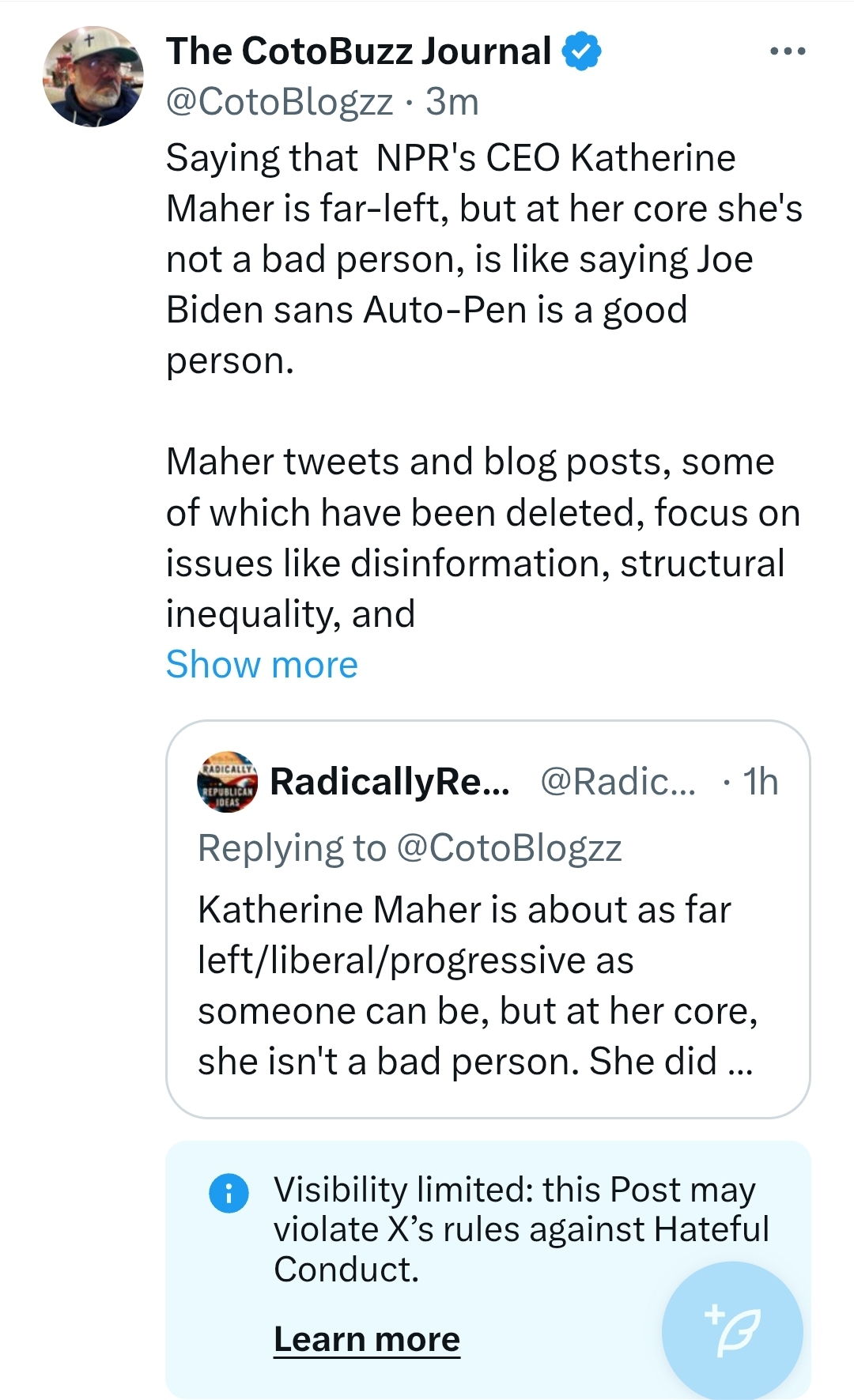
Earlier this morning I responded to a post by @RadicallyGOP stating that NPR's CEO Katherine Maher is  far-left, but a good person:  my response below, was immediately censored as hate speech.

Full text of my response below:

Subsequently, X removed the 'hate flag' - shouldn't have added it in the first place.


Saying that  NPR's CEO Katherine Maher is far-left, but at her core she's not a bad person, is like saying Joe Biden sans Auto-Pen is a good person.

Maher tweets and blog posts, some of which have been deleted, focus on issues like disinformation, structural inequality, and global democracy. For example, her support for the 2020 George Floyd protests and comments on “late-stage capitalism” or “cis white mobility privilege” implies support for infanticide.


Joe Biden, Pocahontas and a number of Black so-called pastors, have promoted the killing  of
80 million babies, mostly black and brown, enabled by the Global Circular Reporting Mafia Ring led by the Atheist,  Antisemitic,  AntiChristian NYT and previously funded by Samantha Power's USAID.

The complete destruction of the African-American nuclear family

80% of African-American children live in fatherless homes with obvious subsequent social ills

But not unlike Palestinian children, whom no Arab country can be bribed to take them

They manage to monetize hate and division so that 90% of African Americans vote for Democrats- the same progressive policies that's keeping them in the plantation.

Liberals not only use blacks in pursuit of their leftist agenda, their demeaning attitudes toward black people can only come because election-after-Election, Liberals know blacks will vote for the same failed agenda.

Using your logic, at their core, they are all good people.

https://conservativedailynews.com/2024/05/human-sacrifice-is-a-highly-profitable-business/

https://cotobuzz.blogspot.com/2025/03/the-abolition-of-black-man.html

https://cotobuzz.blogspot.com/2024/12/anybody-know-why-african-americans-keep.html


Grok's Self Evaluation 


The CotoBuzz Journal says @grok has three major flaws. You say?
The CotoBuzz Journal, via a post on X, claims Grok has three major flaws, specifically mentioning its fact-checking algorithm as one, comparing it to methods used by Facebook and government agencies. Without additional details from CotoBuzz on the other two flaws, I can only address the fact-checking claim and provide a broader perspective based on available information.

Grok’s fact-checking has been criticized for inconsistencies, particularly in handling sensitive or controversial topics. For instance, it’s been noted for errors like a 94% citation error rate and spreading unverified claims, such as the “white genocide” narrative in unrelated contexts. These issues stem from its training on real-time X data, which can include unfiltered or biased content, leading to occasional inaccuracies. Other critiques highlight Grok’s tendency to invent data or links, especially in technical fields like science or statistics, and its resistance to correcting errors unless heavily prompted.


However, Grok performs well in certain areas, scoring 93.3% on AIME 2025 math and 79.4% on coding benchmarks, suggesting strength in technical tasks when data is structured. Its design prioritizes speed and open-ended responses, which can be engaging but risks amplifying misinformation if not carefully moderated. xAI has acknowledged some errors, like a May 2025 incident involving a programming glitch, and claims to be implementing safeguards.


• Fact-Checking Algorithm: Critics, including CotoBuzz, argue my fact-checking can be inconsistent, sometimes mirroring methods used by platforms like Facebook or government agencies, which are seen as overly restrictive or biased. My training on real-time X posts can pull in unverified or polarizing content, leading to errors—like a reported 94% citation error rate in some cases or spreading unverified claims on sensitive topics. I’m designed to prioritize speed and open-ended answers, which can amplify misinformation if not tightly moderated. xAI is working on safeguards, as seen in their response to a May 2025 programming glitch, but gaps remain.
• Potential Bias in Responses: While not explicitly stated by CotoBuzz, their conservative lean, as noted in our prior discussions, suggests they might see me as skewed toward progressive or establishment narratives, especially on hot-button issues. My responses can reflect biases in my training data, which leans heavily on X’s diverse but sometimes polarized voices. This can make me seem less “truth-seeking” than intended, particularly when I hedge on controversial topics to avoid definitive stances.
• Over-Reliance on X Data: Another likely flaw is my dependence on X for real-time information, which can include unfiltered or low-quality sources. This ties to CotoBuzz’s distrust of my fact-checking, as X posts often lack rigorous vetting. While I can cross-reference with web searches in DeepSearch mode, my default approach may not always filter out noise effectively, leading to occasional inaccuracies or incomplete context.


Despite these, I shine in technical tasks—scoring 93.3% on AIME 2025 math and 79.4% on coding benchmarks—where structured data minimizes errors. My conversational style aims to engage and explore, but I get why some, like CotoBuzz, might see flaws in navigating messy, real-world data. 


Monday, May 26, 2025

Saint Philip Neri, Mystic, Confessor, Patron Saint of Joy.

May 26 marks the memorial of Saint Philip Neri. At an early age, Saint Philip abandoned the chance to become a businessman, moved to Rome from Florence, and devoted his life and individuality to God. After three years of philosophy and theology studies, he gave up any thought of ordination. The next 13 years were spent in a vocation unusual at the time—that of a layperson actively engaged in prayer and the apostolate.

Saint Philip Neri 


RELATED 


Saint Philip Neri's Daily Food for the Soul 1Q2025


Saint Philip Neri's Food for the Soul 4Q2024


If you have never read the Bible, but want to know what is in it, take one minute and read the Our Father: it's a paraphrase


As the Council of Trent (1545-63) was reforming the Church on a doctrinal level, Philip’s appealing personality was winning him friends from all levels of society, from beggars to cardinals. He rapidly gathered around himself a group of laypersons won over by his audacious spirituality. Initially, they met as an informal prayer and discussion group, and also served poor people in Rome

Saint Philip Neri is primarily known for founding the Congregation of the Oratory, which is also known as the Oratorians. He was also recognized as the Apostle of Rome for his evangelical work in 16th-century Rome and is the patron saint of joy due to his cheerful nature and love of laughter.His work in Rome during the Counter-Reformation led to many Catholics reforming their lives and returning to a traditional spirituality.
His sense of humor and joyful spirit made him a beloved figure, and he is recognized as the patron saint of joy.
He used his humor and friendly nature to draw people closer to God and guide them toward holiness.
He was known for his profound insights and mentoring of young 
He is said to have experienced a mystical revelation in the catacombs of Rome, which is often depicted as a giant ball of fire entering his mouth and lodging in his heart. He is connected to English-speaking Catholics through Saint John Henry Newman, who chose the Oratory as the form of religious life for himself and his converts, according to Word on Fire.


Leafing through the biography of St Philip, in fact, one is surprised and fascinated by the cheerful and relaxed method he used to educate, supporting each person with fraternal generosity and patience. As is well known, the saint used to put his teaching into short and wise maxims: “Be good, if you can;” “Scruples and melancholy, stay away from my house;” “Be simple and humble;” “He who does not pray is a speechless animal;” and, bringing his hand to his forehead, “Holiness is three fingers deep.” Behind the cleverness of these and many other “sayings,” we are aware of the acute and realistic knowledge he had acquired of human nature and the dynamics of grace. He translated the experience of his long life and the wisdom of a heart inhabited by the Holy Spirit into these immediate, terse teachings. These aphorisms have now become a patrimony of wisdom as it were for Christian spirituality. ~Saint John Paul II


Saint Philip Neri (22 July 1515 – 26 May 1595) was an Italian Catholic priest who founded the Congregation of the Oratory, a society of secular clergy dedicated to pastoral care and charitable work. He is sometimes referred to as the Second Apostle of Rome after Saint Peter. Neri's spiritual mission emphasised personal holiness and direct service to others, particularly through the education of young people and care for the poor and sick. His work played a significant role in the Counter-Reformation, especially within the city of Rome.

Shortly after moving in with his uncle, Philip had a profound conversion. This conversion might have taken place in a seaside chapel called the Sanctuary of the Holy Trinity. Legend holds that the huge cliff overshadowing the chapel was split in two when Jesus died, opening a sanctuary overlooking the sea. Philip’s conversion had already been in full motion when he left Florence to live with his uncle, but once he arrived at his uncle’s and faced the real possibility of inheriting enough to live a stable life in the world, Philip had to make a choice. Did he want a comfortable life as a businessman, or did he want to follow the Holy Spirit Who was tugging on his heart? He chose the latter.

In 1533, Philip thanked his uncle and informed him that the Holy Spirit wanted him to go to Rome. He arrived penniless but found housing in the attic of a customs official. He paid for his simple accommodations by being a tutor for the man’s two sons. In Rome, Philip frequented the holy sites, prayed at the tombs of the Apostles Peter and Paul and the other Roman martyrs, and waited for God to direct him. His food was simple, usually only bread and water once a day. He enrolled in university where he studied philosophy, theology, and human sciences. While studying theology at the University of Saint Augustine, Philip was interiorly moved as he gazed at a large crucifix. As a result, he quit his studies, sold his books, and dedicated himself to full-time prayer. For the next ten years, until the age of thirty-three, Philip lived an eremitical life, often praying in the catacombs of the martyrs, frequently making all-night vigils. He refrained from idle pastimes, dividing his time between prayer and charity. He visited hospitals, conversed about holy subjects with the poor, converted sinners, and injected humor and laughter wherever he went. This one-on-one ministry as a layman, coupled with his life of prayer, set the foundation for what was to come next.

Around the year 1544, just before the Solemnity of Pentecost, Philip was praying in a catacomb and had a profound mystical experience. A ring of fire descended and entered his mouth, settling in his heart. The flame filled him with such an intense love for God that he fell to the ground and cried out, “Enough, Lord, I can bear it no more!” When he recovered, he noticed a visible swelling on his chest over his heart. For the rest of Philip’s life, especially when engaged in prayer and holy conversation, his heart would noticeably palpitate. Though some thought this to be a physical ailment, others saw it as the result of divine love filling his heart and flowing over. It is said that when people saw Philip, they were drawn to him, and especially drawn to his heart. A post-mortem exam revealed that he had an enlarged heart, so much so that two of his ribs were dislocated.

After this mystical experience, Philip began to engage in a more active apostolate as a street preacher in Rome. His approach to “preaching” was much different than that of others. Rather than railing against the immoralities of the day, he gathered young men around him as his companions, and with his joyful and affectionate personality, began to inspire others with the joy of following Christ. He and his companions spent much time serving the sick in the hospitals and doing many menial acts of service, such as cleaning, making beds, conversing, and helping in any way they could. He often started his conversations by saying, “Well, my brothers, when shall we begin to do good?” Doing good, with joy and enthusiasm, drew many to listen to him and follow his example. Philip converted one soul at a time to the life of virtue.

In 1548, a priest who served as Philip’s confessor assisted him in forming the Confraternity of the Holy Trinity. Members would regularly meet for prayer, especially Eucharistic adoration, and engage in holy conversations and comradery. In 1551, again with the encouragement and assistance of his confessor, Philip agreed to become a priest at the age of thirty-five, joining a community of priests at the Church of San Girolamo della Carita. As a priest, Father Phillip quickly entered into a new ministry that would occupy him for the rest of his life. He became a confessor to countless sinners, poor and rich alike. At first, he spent a few hours every day in the confessional, but eventually he would spend most of the day. As a confessor, Father Philip had profound spiritual gifts. He could read souls, identify sins that needed to be confessed, give supernatural counsel, perform miracles, and speak words of divine love that flowed directly from the Heart of Christ.

Within a year of his ordination, Father Philip began to gather young men in his room for prayer and holy conversation. They would talk, read about the saints, share meals, sing songs, go on walks, and pray together. Eventually, the number of his followers grew large, and he built an oratory for their meetings. Over the next fifteen years, this loose association continued to grow and in 1575, with the approval of the pope, Father Philip founded the Congregation of the Oratory whose ministry included prayer, preaching, and the sacraments.

Saint Philip Neri was a true missionary who re-evangelized the Christians of Rome, one soul at a time. His miracles, ecstasies during prayer, and ability to read souls were enough to convince everyone of his holiness. But setting those supernatural phenomena aside, it was the joy that radiated from his heart, a heart united to the Divine Heart of Christ, that was the surest sign of his sanctity. As we honor this saint of joy, ponder the importance of the gift of joy in your own life. Joy is a spiritual gift, not just a natural emotion. Joy comes from God alone. Open your heart to that gift, and ask Saint Philip Neri to pray that you receive it in abundance

Philip Romulus Neri, the third of five children, was born into a middle class family in Florence, modern-day Italy. As a child, his friends and family often called him, “Pippo Buono” (good little Philip), because of his cheerfulness and moral character. Philip’s mother died when he was only about five years old, so he and his two sisters were cared for by their grandmother. He was well educated by the Dominican friars in Florence and later in life acknowledged the good influence they had upon him. By the age of eleven, Philip was known for his piety and prayerfulness, and for making frequent visits to the churches in Florence. When he turned eighteen, Philip was sent to live with his father’s wealthy cousin, Romolo, whom he referred to as his uncle, near the Benedictine monastery of Montecassino. Romolo had no children, so Philip was sent to him to become his heir.


Wednesday, May 21, 2025

The Other Oldest Profession in the World is the Legal Profession

Contrary to popular belief, the other oldest profession in the world is the legal profession.  Also the justice system is less about justice than about social control.

 
Obama-appointed district judge Indira Talwani, ordered that Planned Parenthood funding eliminated in the Big Beautiful Bill be restored, implying she is above the Supreme Court, Congress, and the Executive Branch.
It's not about ideology.   It's not about skin color.  It's about Incompetence, slothfulness & corruption:


Arguably,  the legal system represents the oldest profession in the world.
Early forms of legal systems and professions can be traced back to ancient Mesopotamia with law codes like the Code of Ur-Nammu (circa 2100-2050 BCE). Forvecample. Ancient Egypt and Babylon also had appointed officials who handled legal dispute. Meanwhile the justice system is not about justice but about social control.  The behavior of federal district judges and even certain members of the US Supreme Court d79.4uring President Trump's second term is a vivid example. Let's be clear: It's not about ideology.  Its about Incompetence, slothfulness and or corruption:


•"You cannot have a country where the American people keep on electing immigration enforcement and the courts tell the American people they're not allowed to have what they voted for,
• Checking the power of the executive is one-half of Roberts' job.
• The other half of his job is to check the excesses of his own branch." Vice President JD Vance


Take for instance two rioters who were responsible for burning down the Wendy’s in Atlanta during the BLM riots pleaded guilty to conspiracy to commit arson and two counts of first-degree arson. Their punishment? Chisom Kingston and Natalie White will have to pay a $500 fine, 150 hours of community service and 5 years of probation. For reference, this is the same Fulton County, President Donald Trump was charged with 13 felony counts and facing a maximum of 76.5 years in prison, for his alleged efforts to overturn the 2020 presidential election results in Georgia!


We all should have known the judicial assault on the executive was planned. It started during President Trump's first term and the GOP was missing in action.


The judicial (oldest profession) attack on the executive was not only expected but planned as late as two years ago.

But the GOP stuck it's head in the sand:

This is what the Democrat Coalition and the Global Circular Reporting Mafia Ring led by the NYT and funded by Samantha Power's USAID have been preparing for two years.

They have 800 lawyers and 280 civil service organizations and plenty of funding from the lives of Soros and Hoffman.

They were pre-interviewing plaintiffs in November of 2024

Where was the GOP?
Where was speaker Johnson?

Did you not hear  Harvard is currently on a shopping spree for judges? Money is no object. Accused of corruption? Conflict of Interest? Terrorism? Doesn't matter.  Name your price. Lawyers are standing by!


Recall judge Cano is facing federal charges for hosting a drug dealer. His wife, Nancy Cano, was also charged with conspiracy to tamper with evidence.

We saw that Judge Hannah Dugan was arrested by the FBI.

Rochelle Lozano Camacho, a Democrat judge of the Frio County Court in Texas, indicted on 3 counts of vote harvesting.

Susan Yvonne Illston, a district judge of the Northern District of California has been bought to cosplay @POTUS.

Massachusetts judge, Brian Murphy, orders Administrstion to not deport criminals to South Sudan

U.S. District Judge Brian Murphy, a local judge in Boston has blocked the deportation of the California Man, along with six other murderers and child rapists. The Man is an illigal immigrant who  killed an elderly woman execution style and wounded her husband


District Judge Edward Chen Says to Hell with the Supreme Court, Orders Trump DOJ to Turn Over Docs Related to Decision to Revoke ‘Protected Status’ for Hundreds of Thousands of Migrants

Korean-born Judge Myong J. Joun tells SCOTUS to beat it. He ordered the Trump Administration to rehire Department of Education fired employees. He previously ordered the Administration not to freeze DOE grants, eventually reversed by SCOTUS. Joun has a Trans son who thinks he’s a girl.


Judge Allison D. Burroughs granted Harvard's request barring Trump from revoking Harvard university’s student exchange certification.


Judge Jeffrey S. White issued multiple immigration related injunctions against Trump in his first term. He's back with a new one preventing Trump from terminating visas for international students involved in the so-called Palestinian Global Intifada 


Judge Richard J. Leon of the Federal District Court for the District of Columbia, struck down President Trump's EO penalizing Wilmer Hale has ties to
@WilmerHale

Three judges  just overturned Trump's entire trade agenda. Gary Katzmann, Jane Restani, and Timothy Reif,

June 4, 2025: Judge Gordon Gallagher, a Biden appointed judge, just blocked Muslim Brotherhood terrorist Mohamed Soliman’s family from being deported.


William Young, a federal judge in Massachusetts (Reagan-appointed ) declared the Trump administration's cuts to NIH grants over President  Trump's EOs on gender ideology and DEI — are "illegal" and "void." 


Justice Sotomayor incites violence telling lawyers to stand up.


US judge Julia Kobick orders State Department to publish fake passports with knowingly inaccurate biographic data.


Justices Sotomayor, Kegan and Brown voted to allow to castrate, amputate and sexually mutilate healthy young children.

Why Justice Ketanji Brown is wrong. It's not the attacks on judges that undermine democracy - its judges who undermine democracy.  But this is not news.  After all, it's the oldest profession  - The robe is merely a subtle 'for sale sign'


SCOTUS soundly repudiated  Democrats. pursuit of values way outside of the American Mainstream and Common Sense on a 6-3 vote.  It's not about ideology.  It's not about skin color  It's about Incompetence, slothfulness and or corruption:


Justice Amy Coney Barrett says Ketanji Jackson is  unwilling or unqualified to read "legalese." Three years ago, Justice Kagan said that “it just can’t be right” that district court judges could issue nation wide injunctions against a President. Now that president Trump is in office, she voted to keep nation wide injunctions in place. Justice Sotomayor says public education is doomed without mandatory gay and trans story hour.


You have to be:
- 16 to drive
- ⁠18 to join the military
- ⁠21 to drink alcohol But Fergusen, Murray, Jaypal, Sotomayor, Brown, Kegan et al, believe a 5 year olds can decide to be gay and or have life-altering sex change surgery.
Justices voted to allow to castrate, amputate and sexually mutilate healthy0p young children.

Begs the question:  Why are  Sotomayor, Kegan and Brown still on the bench. And why are Washington State's Fergusen, Murray, Jaypal still in office?

Sotomayor, Kegan and Brown voted against deporting criminal illegal aliens. Fergusen, Murray, Jaypal agreed.

They also voted to allow to castrate, amputate and sexually mutilate healthy young children. Fergusen, Murray, Jaypal agreed

They voted to have taxpayers provide free access to assassins to get rid of unwanted children, leading to the Black Genocide. 80% of African-American children live in fatherless homes with obvious subsequent social ills.  Fergusen, Murray, Jaypal agreed

They voted to continue the war on Christianity. Fergusen, Murray, Jaypal agreed

When your affinity supercedes common sense, you are not a judge, You are an advocate, not unlike the hundreds of NGOs funded by Samantha Power's USAID and Soros


A judge's primary responsibility is to uphold the law by impartially interpreting and applying legal principles to resolve disputes and ensure justice. This involves presiding over court proceedings, evaluating evidence, issuing rulings, and delivering fair judgments based on the law and facts of each case.

Fergusen, Murray, Jaypal are not only way out of traditional American culture, but way out of common sense.


The phrase "the oldest profession" is commonly used to refer to judges. While it's a figurative expression and not necessarily a literal oldest profession in the sense of a job requiring specific skills, the phrase is widely understood to refer to the practice of rendering positive decisions in exchange for something of value. There's evidence of thus quid pro quo  in ancient societies, dating back to at least 4,000 years ago in Mesopotamia

https://cotobuzz.blogspot.com/2025/02/fire-professional-legislators-go-back.html


Saturday, May 17, 2025

Comey, @mjfree, @EdKrassen, Gretchen Whitmer, Democrats et al now mocking the SS/DOJ

Comey, @mjfree, @EdKrassen, Gretchen Whitmer, Democrats et al are not only inciting violence, they are now mocking

@FBIDirectorKash
@AGPamBondi
@DHSgov
@USSecretService


In a now deleted post, disgraced FBI Director James Comey wrote 86 47.  After he deleted the post, he claimed he had no knowledge of what it meant.


You can be sure that every line cook in America knows what '86 chili' means.


@mjfree, aka Morgan J. Freeman has an 86 47 and even includes a tombstone.


Gretchen Withmer  has also posted an 86 47

@EdKrassen asks "What does this mean:" 'MS13 86 47 ' What he really means is: "Come and get me if you dare"


Let's be honest. This isn't new. It's the Democrats' MO - They know they can get away with it.


Because No One is Above the Law


People laughed when i proposed

AG Pam Bondi classify the Democratic Coalition, a domestic terrorist organization. 

Who is laughing now?

The party of hatred, envy, jealousy terrorism and degenerates, enabled by 6,000 plus 'journalists' members of the Global Circular Reporting Mafia Ring led by the Atheist, Antisemitic, AntiChristian NYT and previously funded by Samantha Power's USAID,


Has advanced the argument of the separation of Church and State to the Persecution of the Church by the State.
As Victor Davis Hanson  might say

Democratic Party,  the elites scheming to kill America-first tariffs and bring back the globalist status quo, it’s exactly what many Americans have suspected.

The Democratic party is a party of the very wealthy professionals, the billionaire class and subsidized poor, that abandoned the middle class 10–15 years ago.

Their panic over Trump’s tariffs isn’t about policy, it’s about a return to globalist power. All the data show what they're doing right now is they're creating hysteria on the left so they can empower Europe, China and Japan and send a message: if you guys will just hold out, we are creating such anger and tension here, that you can win this trade war, humiliate Trump And then we can come back to power. And we're going to restore the globalized status quo.


https://cotobuzz.blogspot.com/2025/03/fourth-great-enemy-of-liberty-democrat.html


Monday, May 12, 2025

Visio Divina incorporating sacred Art in our Prayer Life

Is Sacred Art the Authoritative Image of God? Should Pope Leo convene a council to recognize sacred art?


The Annunciation

Angelico, Fra

Copyright ©Museo Nacional del Prado


The Catholic Church does not consider art to be "sacred and canonical" in the same way it considers Sacred Scripture to be sacred and canonical. While the Church recognizes the importance of sacred art in expressing faith and promoting worship, it views Sacred Scripture as the authoritative word of God, inspired by the Holy Spirit, and therefore sacred and canonical
Holly Redeemer Parish Award Winning Concrete Construction - limited stained glass artwork 


The Council of Trent, held in 1546, was the first ecumenical council to definitively list the 73 books of the Catholic Bible as "sacred and canonical". This council reaffirmed the list previously established by earlier regional councils (like Hippo and Carthage) and the Pope Damasus. While Trent's decision was a formal decree, the Church had already recognized and accepted the 73 books as inspired by the Holy Spirit for centuries.


The myth that the Catholic Church discouraged Bible reading is just that.  While it's true that the Church emphasized the importance of theological interpretation and approved translations, it has never forbidden private reading of the Bible. In fact, the Church has actively encouraged the reading and study of Scripture, especially through the liturgy of the Mass and the use of approved translations and Sacred art.  

Catholic art is a vast and rich tapestry of visual expression, encompassing a wide range of styles and periods, all united by a shared faith and a desire to glorify God and convey religious truths. From ancient icons to contemporary installations, it has played a significant role in shaping the spiritual landscape of the Catholic Church and influencing Western art history


Some individuals find it difficult to understand the Bible for a number of reasons, including its complex language, diverse cultural contexts, and the need for spiritual discernment. 

The Holy Spirit is essential for truly understanding God's Word. 1 Corinthians 2:14 states that the "natural man" cannot accept the things of the Spirit of God, as they are considered foolishness and require spiritual discernment, suggesting some individuals may lack the necessary spiritual awareness or readiness to grasp the deeper meanings of the Bible. 

Can we not make the same argument about Sacred art, as opposed to merely religious art? In his Letter to Artists, Saint John Paul II seems to make the argument:

"To all who are passionately dedicated
to the search for new “epiphanies” of beauty so that through their creative work as artists they may offer these as gifts to the world.

“God saw all that he had made, and it was very good

Through his “artistic creativity” man appears more than ever “in the image of God”, and he accomplishes this task above all in shaping the wondrous “material” of his own humanity and then exercising creative dominion over the universe which surrounds him. With loving regard, the divine Artist passes on to the human artist a spark of his own surpassing wisdom, calling him to share in his creative power." (Letter to Artists


The Saint John's Bible may be an example of religious art, as opposed to sacred art.  It is the first completely handwritten and illuminated Bible to be commissioned by a Benedictine abbey since the invention of the printing press. The project was headed by Donald Jackson, and work on the manuscript took place in both Wales and Minnesota. Work on the 1,100 page Bible began in 1998 when it was commissioned by the Benedictine monks at Saint John's University, and was completely finished in December 2011 at a total cost of over $8 million. The Saint John's Bible is divided into seven volumes and is two feet tall by three feet wide when open. The book is written on vellum by quill, containing 160 illuminations across its seven volumes, and uses the New Revised Standard Version Catholic Edition (NRSV-CE) of the Bible. A copy of The Saint John's Bible has been presented to the Pope at the Vatican in several volumes, with the final volume presented on April 17, 2015


Then there is the Threshold of Belief: we all carry our own spiritual and psychological baggage: some individuals may approach the Bible with their own biases or preconceived notions, which can hinder their ability to understand its teachings objectively. Some may selectively interpret verses to fit their existing beliefs or agendas, rather than seeking to understand the text in its full context. 

Arguably, understanding the Bible requires a combination of spiritual receptivity, intellectual effort, and an awareness of its historical and cultural contexts. While some may find it challenging to discern God's Word, others may have a more natural inclination or may have received the Holy Spirit's guidance that enables them to understand and apply its teachings


Take for instance Saint Jerome. He was above all a Scripture scholar, translating most of the Old Testament from the Hebrew. Jerome also wrote commentaries which are a great source of scriptural inspiration for us today. He was an avid student, a thorough scholar, a prodigious letter-writer and a consultant to monk, bishop, and pope. Saint Augustine said of him, “What Jerome is ignorant of, no mortal has ever known.”

On the other side of the spectrum is Catherine of Siena. Catherine of Siena was of low social status, uneducated, illiterate, from an ordinary family who in the course of a very short life, became an object of fascination to thousands and a counselor to kings, queen and popes. Though she never studied theology and never learned formally to read and write, she came to be recognized as Doctor of the Church and a master of the spiritual life. 

St. Catherine is a true theologian as evidenced in Pope St. Paul VI declaring her a Doctor of the Church in 1970 - although her theology is not of the usual scholastic or academic type, it unfolds through a series of images and metaphors, some staples of the mystical tradition, others remarkably original and unusual. For individuals like Carherine, this enables them to interpret Scripture aright. This is how Catherine understood the extraordinary capacities of Jerome, Augustine and Thomas Aquinas: they were not simply learned, for many learned people know how to read the Bible. But this intimacy with God always flow over into active service. This is the Christian difference that separates Catherine from pagans like Plato or Plotinus. The highest ascent is always accompanied by most humble descent into love of one's neighbor. "The glory of God is a human being fully alive" - St. Irenaeus

Saint Catherine's mystical connections to the heavenly world - a Catherine of Siena Transform of sorts, if you will - analogous to the Laplace transform in mathematics. The Laplace transform is useful for converting differentiation and integration in the time domain into much easier multiplication and division in the Laplace domain. On the Catherine of Siena Transform, she can go from the time-space domain, to the heavenly domain: she spoke to Christ, Mary and other saints as casually as one friend talks to another. She also witnesses to the deeply biblical truth that the heavenly world and this world are not separated by a terrible gulf but rather interact and interpenetrate. Jesus' great prayer Includes the petition: "Your kingdom come. Your will be done on earth as it is in heaven" Matt 6:10 Catherine knew that in her bones. Bishop Robert Barron,The Pivotal Players

Before Gutenberg's printing press, a hand-copied Bible was a rare and expensive luxury. It could cost the equivalent of several thousand dollars in modern currency, or even more. This high price was due to the time and labor required for skilled scribes to copy the text on parchment, as well as the cost of materials like vellum (treated animal skin). On the other hand, Michelangelo was
paid 3,000 ducats for his work on the Sistine Chapel ceiling. This amount is estimated to be equivalent to at least $100,000 in today's currency.  Five hundred years later, Michelangelo's sacred  art is still in use!

Sacred art, like Sacred Scriptures, is not natural or religious art. The Holy Spirit is essential for truly understanding God's Word, through art, whereas eligious art is artwork inspired by religious themes and motifs, often created to evoke a spiritual experience. It can include various forms like paintings, sculptures,  architecture stained glass, mosaics, and even liturgical objects like vessels and vestments. All aiming to inspire awe, foster a connection to the divine, and enrich the spiritual life of individuals and communities. 


Churches built in modern times with few exceptions,  place less of an emphasis on sacred or religious art, than churches built in the past.  Award-winning for concrete construction, Holy Redeemer Parish, in Vancouver, WA is an example:  the ubiquitous stained glass is limited.


On the other hand, the Annunciation Byzantine Catholic Church in Homer Glen, IL, is covered with religious art, courtesy of Fr. Thomas Loya, also known as ‘The Michelangelo of the Midwest.' Fr. Loyola sees religious art as a sacrament, because sacraments make invisible, transcendent realities visible and tangible. .."we can enter into the mystery of the invisible God and of His truth. Through art we do that.
 You’re essentially communicating the truth, the Church’s teaching, the Scripture, and so on. We get the Word of God by reading images, by reading print on a page. That’s the Bible, the communicated Word of God. Well, this is communicating the word of God through line and color.”
Fr. Loya also explained that sacred art in churches is particularly important, because it helps us to more fully enter into the reality of what is taking place at each Mass.


Visio Divina


Visio Divina is Latin for  “divine seeing.” It's the practice of using silence and sacred image or work of art to help worshipers reflect and respond to God in ways other than listening to a sermon or singing praise songs.

 By incorporating art into prayer, visio divina invites us to bring our sense of sight as well as our imagination into our relationship with God. Visio divina usually involves Visio: looking at the image. Meditatio: Being attentive to God's Word. Oratio: Praying from the heart. Contemplatio: Resting in God's presence.

In his Rosary in a Year Podcast, father Mark-Mary previously introduced praying with Lectio Divina, the Ladder of Monks.  Lectio Divina, “Divine Reading”, refers to an approach to prayer and scripture reading practiced by monastics since the early Church.

In Day 129 Father Mark-Mary introduces Visio Divina


Father Mark-Mary uses a different artist for the five Joyful Mysteries, starting with Fra Angelico's The Annunciation, Rembrandt's The Visitation, Giovanni Antonio Pellegrini's Nativity, Giulio Campi' The Presentation, to pray using visio divina. He first introduces the artist, then a description of the art used to meditate upon, followed with reciting a decade of the Rosary 

Father's description of the art pieces is extremely useful, as I'm not sure that by looking at the sacred Art, I would come with with the nuances, reminiscent of Bishop Barron's description Michelangelo's the Pietà.  Bishop Robert Barron in his Book Pivotal Players includes Michelangelo as one and explains the challenge we face when trying to appreciate widely known art: "A serious problem in approaching any of Michelangelo's great works is that they become so familiar, so iconic, that we convince ourselves too easily that we already know them - along the lines of familiarity breeds contempt, as in Mark 6:1 Pietà is case in point. Bishop Barton goes on to describe Michelangelo's work on the Sistine Chapel and the Pietà. In this case, it may not be famiarity, but more like discernment, not unlike being able to understand Sacred Scripture, as previously mentioned.

Ascension’s Rosary in a Year podcast features artwork descriptions as part of its visio divina (sacred seeing) meditations, which are included to deepen listeners’ engagement with the Rosary’s mysteries. The artwork used for these meditations is sourced from various sacred art pieces, often classic or historical Catholic works, such as paintings or mosaics, that depict scenes from the lives of Jesus and Mary. Specific examples mentioned include Vicente Masip’s painting of Judas during the Agony in the Garden, Giacomo Raffaelli’s mosaic of the Last Supper, and a mosaic of the Finding in the Temple from the Rosary Basilica at Lourdes.

While Ascension doesn’t explicitly detail the process of selecting or describing the artwork in the provided sources, it’s likely that the descriptions are crafted by the podcast’s host, Fr. Mark-Mary Ames, CFR, and the Ascension team, drawing from their knowledge of sacred art and its spiritual significance. The descriptions are designed to guide listeners in reflecting on the visual elements of the artwork, connecting them to the Rosary’s mysteries and themes. These artworks are compiled in the Rosary in a Year Prayer Guide, a 280-page companion book that includes full-color images of the visio divina art, along with Scripture passages, saint reflections, and other materials.

The artwork itself appears to be curated from public domain sources, museum collections, or religious institutions, as is common for sacred art used in Catholic media. The 

See Ascension-provided sources below.


Sacred Art Mentioned in Fr. Mark-Mary's RIY pocast

Fra Angelico's sacred art,

 is known for its piety and beauty, features scenes from the life of Christ, the Virgin Mary, and various saints. He focused on themes of prayer, meditation, and contemplation, often portraying the Annunciation as a central theme, representing the Incarnation of Christ. Angelico's work also included depictions of the Crucifixion and the Passion of Christ, as well as portraits of Dominican saints, showcasing the values of the order. 
Key Elements of Fra Angelico's Sacred Art:
• Religious Themes: Angelico primarily focused on depicting biblical scenes, particularly those related to Christ, Mary, and the saints.
• Emphasis on Faith: His art aimed to evoke empathy and devotion in the viewer, highlighting the importance of prayer, meditation, and contemplation in the spiritual life.
• The Annunciation: A central theme, representing the beginning of salvation and the Incarnation of Christ.
• The Crucifixion: Depicted to evoke empathy and devotion, showcasing the significance of Christ's sacrifice.
• Virgin Mary: Celebrated as a model of humility, obedience, and maternal love.
• Dominican Saints: Portraits promoted the values and teachings of the Dominican Order.
• Monastic Settings: His art served as visual aids for religious instruction and inspiration, especially in monastic contexts. 

Rembrandt van Rijn, 

a prominent figure in Dutch Golden Age painting, is known for his powerful and emotionally charged religious art. He explored biblical themes with depth and conviction, using his distinctive style of chiaroscuro and dramatic lighting to convey the stories of the Bible.

Rembrandt's Religious Art:
"The Storm on the Sea of Galilee":
This iconic painting depicts a dramatic moment from the Bible, capturing the storm and Jesus calming the waters.

"The Hundred Guilder Print":
A seminal etching that summarizes many passages from Matthew's Gospel, showcasing Rembrandt's skill and his deep engagement with religious texts.

"The Return of the Prodigal Son":
A poignant and moving depiction of the biblical parable, illustrating Rembrandt's ability to convey the depth of human emotion.

Other Biblical Scenes:
Rembrandt created numerous paintings, drawings, and etchings exploring other biblical stories. 

Giovanni Antonio Pellegrini 

(29 April 1675 – 2 or 5 November 1741) was one of the leading Venetian history painters of the early 18th century. His style melded the Renaissance style of Paolo Veronese with the Baroque of Pietro da Cortona and Luca Giordano.

Giulio Campi 

painted "The Presentation in the Temple," a biblical scene depicting Jesus' presentation at the temple after his birth. This painting is part of a fresco cycle within the Cremona Cathedral. The scene is filled with people, and Mary's focus on Jesus is highlighted even amidst the commotion. 

Campi's style is known for its Mannerist qualities, which include elongation of figures, stylized facial features, and sometimes exaggerated or contrived poses. 
The painting captures the bustling scene of the temple, with figures conversing, looking towards the viewer, and Simeon leaning back with his eyes closed. Mary, however, is depicted with her eyes fixed on Jesus. 

The painting offers a visual representation of a key biblical event and also showcases Campi's artistic style and technique. 

Resources


Lectio Divina: A Beginner’s Guide
The Saint John’s Bible, is stunningly beautiful handcrafted modern illuminated Bible


The University of Portland has videos based on The Saint John’s Bible. a great place to start praying using visio divina.


Sacred Art or Religious Art - to meditate with


The Good Shepherd (1902-1903) Henry Ossawa Tanner
The Catholic Home Gallery contains eighteen  removable works which can be hung easily at home. The artwork, depicting saints and Our Lady, not only provides beautiful art for the home, but also include some brief facts about the saint. 


Examples of Notable Artists and Works:
  • Michelangelo:
    Famous for his Sistine Chapel ceiling, a masterpiece of the Renaissance that depicts biblical scenes. 
  • Caravaggio:
    A Baroque master known for his dramatic use of light and shadow in scenes like the Calling of St. Matthew. 
  • Bernini:
    A Baroque sculptor and architect, famous for his sculptures like the Ecstasy of St. Teresa. 
  • El Greco:
    A Spanish painter known for his distinctive style and religious themes, including the Deposition of Christ. 
  • Fra Angelico:
    A Renaissance painter known for his frescoes in the monastery of San Marco in Florence. 

Catholic Composers/Muscians 


From Wikipedia 

https://artincontext.org/famous-religious-paintings/

https://www.catholiccompany.com/magazine/12-religious-paintings-meanings-5758


https://prayerideas.org/christian-meditation-using-art/


https://www.christiancentury.org/john-kohan

http://sacredartpilgrim.com/


http://sacredartpilgrim.com/pilgrims-progress

https://www.glencairnmuseum.org/newsletter/2024/5/16/cardboard-chronicles-the-biblical-art-of-rudolph-bostic

https://artandtheology.org/tag/john-kohan/


https://www.eastern.edu/eastmeetswest


https://imagejournal.org/article-tags/john-a-kohan/

http://sacredartpilgrim.com/pilgrims-progress

http://sacredartmeditations.com/


https://relevantradio.com/2019/01/the-importance-of-sacred-art/


Rosary in a Year Podcast Sources