Our mission is to comfort the afflicted and afflict the status quo. Independent journalism with a focus on politics and satire, public safety, judicial misconduct, government corruption, HOA/CID, senior advocacy, sanctity of life & marriage and a voice to the voiceless
If you have never read the Bible, but want to know what is in it, take one minute and read the Our Father: it's a paraphrase
And if you want more detail, just read the Rosary. It's a compendium.
Just like there are levels of worship, there are levels of prayer. Within Christianity, distinct forms of worship are found, each one of them carrying specific connotations and finding different devotional expressions. These levels of venerationare traditionally known as dulia, proskynesis, hyperdulia, and latria. Where latria is reserved for the type of worship due to God alone. These other three types of veneration are used to refer to the veneration given to angels, saints, relics, icons, and the Virgin Mary. Indeed, veneration is a type of honor distinct from the true worship (that is, adoration), which is due to God alone.
The types of prayer in the Bible include. Vocal prayer: Using words either audibly or mentally. Meditation: Focusing on God or meditating on some mystery without words. Intercession: Praying for the needs of other people. Prayer of thanksgiving: Showing gratitude for what God has done. Prayer of worship: Recognizing God's power and greatness. Contemplative prayer: Using the mind, heart, and sometimes imagination to recognize God's presence. Prayer of authority: Exercising God's authority
Some authors group prayers in categories, such as:
—Purgative Way— 1. Vocal Prayer 2. Mental Prayer 3. Affective Prayer 4. Acquired Recollection Bridge: Dark Night of the Senses —Illuminative Way— 5. Infused Contemplation 6. Prayer of Quiet Bridge: Dark Night of the Soul —Unitive Way— 7. Simple Union 8. Conforming Union 9. Transforming Union
Grades of Prayer 1 & 2 Grades of Prayer 3 & 4 Grades of Prayer 5 Grades of Prayer 6 & 7 Grades of Prayer8 & 9
Ecstatic prayer is a type of prayer that involves heightened emotions to connect with the divine. It can involve a sense of joy, fervor, and an overwhelming presence of God. Ecstatic prayer can lead to spiritual experiences that go beyond traditional boundaries. It can promote personal transformation and community bonding. L It can involve a sense of God's presence through physical aspects of worship, such as music and movement.
In Catholicism, ecstasy is a term used to describe a state where a person is completely occupied by God.
Ecstatic prayer can involve practices such as praying in tongues and praying with verbal icons.
How to Pray: the Ladder of Monks
Father Mark-Mary's Podcast Rosary in a Year Podcast illustrates the Ladder of Monks
Lectio Divina, “Divine Reading”, refers to an approach to prayer and scripture reading practiced by monastics since the early Church.
In the 11th century, a Carthusian prior named Guigo formalized how to pray in a letter written to a fellow religious. This letter is known as The Ladder of Monks and describes a four-runged ladder to Heaven, each rung being one of the four steps in his method of prayerful scripture reading:
Lectio (reading): An attentive, slow, repetitious recitation of a short passage of scripture.
“looking on Holy Scripture with all one’s will and wit”
Meditatio(meditation): An effort to understand the passage and apply it to my own life.
“a studious searching with the mind to know what was before concealed”
Oratio (prayer): Engaging or talking with God about the passage.
“a devout desiring of the heart to get what is good and avoid what is evil”
Contemplatio (contemplation): Allowing oneself to be absorbed in the words of God as the Holy Spirit draws us into His presence through scripture.
“the lifting up of the heart to God tasting somewhat of the heavenly sweetness”
Those who scoff at the power of prayer- like the scientists at the New York Times, reject Sacred Scripture and deny the God of Abraham, Isaac and Jacob
Not only did Jesus teach his disciples how to pray the pater noster (Our Father,) Jesus himself as a child, learned to pray from his earthly father.
"Whoever says, “I know him,” but does not keep his commandments is a liar, and the truth is not in him. 「But whoever keeps his word, the love of God is truly perfected in him. This is the way we may know that we are in union with him:" 1 John 2
You may recall the story of sisters Mary and Martha as told by Saint Luke in Chapter 10. Martha is worried about the day to day things, while Martha listens to Jesus: "Martha had a sister named Mary [who] sat beside the Lord at his feet listening to him speak. Martha, burdened with much serving, came to him and said, “Lord, do you not care that my sister has left me by myself to do the serving? Tell her to help me.” The Lord said to her in reply, “Martha, Martha, you are anxious and worried about many things. There is need of only one thing. Mary has chosen the better part and it will not be taken from her.” should I worry first and pray later?
In the piece How to Use the Old Testament in Daily Prayer Father Thomas Weinandy, OFM Cap writes about how Jesus, as a child learned to pray from his earthly father. "In France I once saw a statue carved out of a huge tree trunk. The statue portrayed the young boy, Jesus, sitting on Joseph’s lap. Joseph had his arms outstretched around Jesus holding out before both of them a scroll and together, with mouths in full voice, they were singing the Psalms in prayer. By praying the Psalms with his foster father, Jesus came to know the love and kindness of his eternal Father, and so came to know that he was truly the Father’s Son. The Psalms and Canticles of the Old Testament are to be foundation of our Christian prayer – of praying to the Father in union with Jesus through the power of the Holy Spirit. Any of us who have prayed the Psalms know that they express the whole range of human emotions and feelings – joy, sadness, fear, love, praise, anger, etc. We tend to gravitate to those Psalms that express the emotion that we are presently experiencing. If we are sad because of the death of a loved one, we pray Psalm 23, “The Lord is my shepherd;/ there is nothing I lack."
The Catholic Catechism cites Tertullian as saying that the pater noster (Our Father) is a paraphrase of the whole gospel: The Lord's Prayer "is truly the summary of the whole gospel." - Tertullian, De orat. 1: PL 1, 1155. "Since the Lord . . . after handing over the practice of prayer, said elsewhere, 'Ask and you will receive,' and since everyone has petitions which are peculiar to his circumstances, the regular and appropriate prayer [the Lord's Prayer] is said first, as the foundation of further desires." - Tertullian, De orat. 10: PL 1, 1165; cf. Lk 11:9. - (CCC 2761)
In paragraph (2559) the CatholicCatechism teaches “Prayer is the raising of one’s mind and heart to God or the requesting of good things from God.” But when we pray, do we speak from the height of our pride and will, or “out of the depths” of a humble and contrite heart? He who humbles himself will be exalted; humility is the foundation of prayer, Only when we humbly acknowledge that “we do not know how to pray as we ought,” are we ready to receive freely the gift of prayer. “Man is a beggar before God.”
While the pater noster is a paraphrase of the gospel, as Tertullian stated, the Rosary is a compendium of the gospel- it reflects on the whole liturgical cycle that the Church commemorates during the course of each year
There are twenty mysteries reflected upon in the Rosary, divided into the five Joyful Mysteries, five Luminous Mysteries five Sorrowful Mysteries and five Glorious Mysteries. The mysteries of the Rosary are based on the incidents in the life of Our Lord Jesus and His Mother that are celebrated in the Liturgy. Some of the Popes have referred to the Rosary as a compendium of the Gospel
While the New York Times thinks prayer is overrated, Saint Padre Pio views prayer as a weapon. “Prayer is the best weapon we possess, the key that opens the heart of God. Saint Philip Neri's Maxim for November
11 reads "It is an old custom with the servants of God always to have some little prayers ready, and to be darting them up to heaven frequently during the day, lifting their minds to God from out of the filth of this world. He who adopts this plan will get great fruit with little pains."
Faith and Works
The calling of the Christian is to live a life of faith and action. Saint James in Chapter 2 tells us "What good is it, my brothers, if someone says he has faith but does not have works? Can that faith save him? If a brother or sister has nothing to wear and has no food for the day, and one of you says to them, “Go in peace, keep warm, and eat well,” but you do not give them the necessities of the body, what good is it? So also faith of itself, if it does not have works, is dead. Indeed someone may say, “You have faith and I have works.” Demonstrate your faith to me without works, and I will demonstrate my faith to you from my works. You believe that God is one. You do well. Even the demons believe that and tremble. Do you want proof, you ignoramus, that faith without works is useless? Was not Abraham our father justified by works when he offered his son Isaac upon the altar?You see that faith was active along with his works, and faith was completed by the works. Thus the scripture was fulfilled that says, “Abraham believed God, and it was credited to him as righteousness,” and he was called “the friend of God.” See how a person is justified by works and not by faith alone. And in the same way, was not Rahab the harlot also justified by works when she welcomed the messengers and sent them out by a different route?.For just as a body without a spirit is dead, so also faith without works is dead." Pray for the hungry and feed him
When All You Have Left is Faith.
You know about faith, about works and about faith and works, and all you have left is faith.
After months of battling several maladies, my sister suffered a number of strokes that have letter unable to move and unable to speak. Doctors have tried a number of procedures, including tomography, yet they have no clue as to what to do next.
For months, we have been to praying to Saint Judas Thaddaeus, one of the Twelve Apostles of Jesus and the patron saint of desperate cases and lost causes to intercede for us - Saint Judas Thaddeus is venerated by millions of people worldwide, he is believed to have miraculous powers, and his intercession is often sought for difficult or seemingly impossible situations. Prior to her strokes, I thought I was praying for a number of desperate cases. These were not desperate cases. We continue to ask for Saint Judas' intercession. In the end, God's will be done.
Thy Will or Your Will?
Choosing to believe the New York Times or Padre Pio, largely determines whose will is more important; yours or God's? As C. S. Lewis writes: "There are only two kinds of people in the end: those who say to God, "Thy will be done," and those to whom God says, in the end, "Thy will be done." All that are in Hell, choose it. Without that self-choice there could be no Hell. No soul that seriously and constantly desires joy will ever miss it. Those who seek find. Those who knock it is opened."
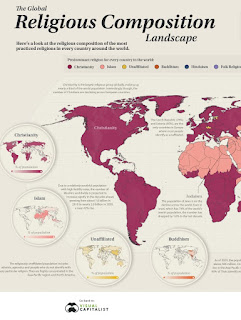
I have argued that the biggest threat to Europe, Africa & the Middle East is not Russia or the Taliban, but Islam. The Biggest Threat to China is not Russia or the USA but Christianity in general & Pope Francis specifically. In fact, Christianity has been a threat to authoritarian regimes for 2 000 years.
You may recall that On April 6, 2009, President Obama, speaking in Turkey, effectively proclaimed that the United States did not consider itself a Judeo-Christian nation.
Christianity in the world
"Although, as I mentioned, we have a very large Christian population, we do not consider ourselves a Christian nation or a Jewish nation" - "fact checkers immediately went to work to refine what Obama actually said - very much along the lines of rewriting history. Ditto for the statement: " I will stand with the Muslims should the political winds shift in an ugly direction." included in his book Dreams of My Father. Again self-proclaimed fact checkers came in to argue semantics. While we can argue semantics ad nauseum, the fact speak for themselves: Obama, like Joe Biden, a self professed Christian,
On July 7, 2016, Russian President Vladimir Putin signed into law a package of amendments with the declared purpose of countering terrorism and ensuring public safety. These amendments, known as the Yarovaya law, which went into effect July 20, present a number of severe restrictions to religious freedom, essentially banning preaching, praying, proselytizing, and disseminating religious materials outside of officially-designated locations. Writes Religious Freedom Institute's Elizabeth A. Clark.
It is no coincidence that the main reasons for Russia's annual population decline are high death rate, low birth rate, high rate of abortions, and a low level of immigration. According to the U.S. Central Intelligence Agency's World Factbook, Russia has a very high death rate of 13.4 deaths per 1000 people per year. In 2005, 1.6 million abortions were registered in Russia; 20% of these involved girls under the age of 18. Official statistics put the number of abortions at 737,948 in 2016. As of 2010, the abortion rate was 37.4 abortions per year per 1000 women aged 15–44 years, the highest of any country reported in UN data. While in the U.S. we have Black Genocide: The killing of preborns, mostly African American, enabled by progressive policies and the main stream media, Russia has its own genocide as a result of banning Christianity
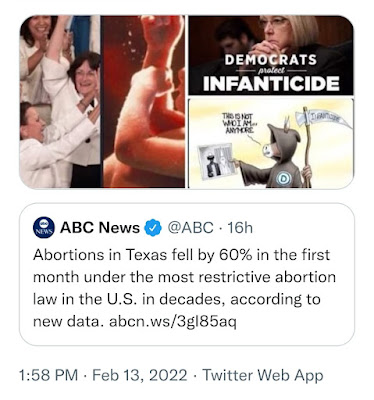
Using the same data, ABC News could have accurately reported that the Killing of preborns was down by 60% in Texas in the first month under the most pro-life law in the U.S. - but decided to support the killing lobby
Christianity in a most restrictive environment was the religious self-identification of 47.1% of the Russian population in 2012 according to Atlas. Whereas Ukraine is an overwhelmingly Orthodox Christian nation, much larger than that of the United States and overwhelmingly much larger than that of the United Kingdom at around 55%
The history of the Church is full of many Martyred saints, who received recognition for great deeds or meritorious conduct. Many lost their lives in defense of the faith, while others were themselves the mothers of important saints. Many were also honored for their contributions to the Church and their community. Catholic Online writes that "The Greek word martus signifies a witness who testifies to a fact of which he has knowledge from personal observation. It is in this sense that the term first appears in Christian literature; the Apostles were "witnesses" of all that they had observed in the public life of Christ, as well as of all they had learned from His teaching, "in Jerusalem, and in all Judea, and Samaria, and even to the uttermost part of the earth" ( Acts 1:8 )
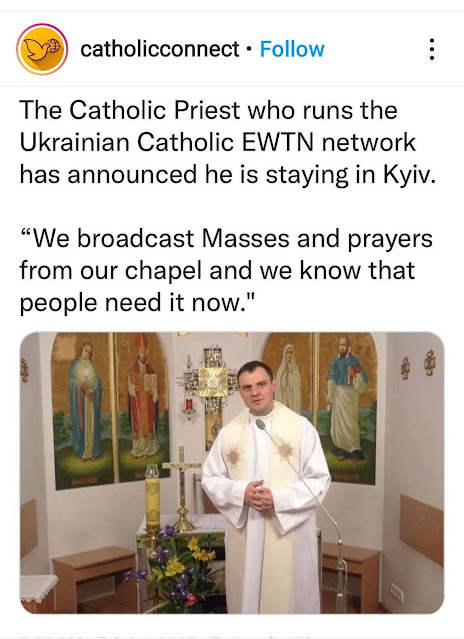
Today, the Catholic Priest who runs the Ukranian Catholic EWTN network decided to stay in Kyiv, rather than to flee.
Ukraine Priest willing to be martyred
St Thomas Aquinas posited that to one who has faith no explanation is necessary to one without faith no explanation is possible: While Wikipedia diminishes the power of prayer "The efficacy of prayer has been studied since at least 1872, generally through experiments to determine whether prayer or intercessory prayer has a measurable effect on the health of the person for whom prayer is offered. Empirical research indicates that prayer and intercessory prayer have no discernible effects." The Anti Catholic New York Times goes even further: At least one earlier study found lower complication rates in patients who received intercessory prayers; others found no difference. A 1997 study at the University of New Mexico, involving 40 alcoholics in rehabilitation, found that the men and women who knew they were being prayed for actually fared worse." In a study by the US National Library of Medicine National Institute of Health concludes. "We believe that the research has led nowhere, and that future research, if any, will forever be constrained by the scientific limitations that we outline."
On the other hand, the Catholic Church believes miracles are works of God such as healing miracles- Jesus healed people who were sick or disabled. Exorcism. the act of freeing someone of demons. Restoration of Life -there are three occasion in the gospel eyes Jesus raises people from the dead and Nature miracle - a miracle in which Jesus shows his power over nature.
James 5:13 tells us about the power of prayer in "The Prayer of Faith Is any one among you suffering? Let him pray. Is any cheerful? Let him sing praise. 14 Is any among you sick? Let him call for the elders of the church, and let them pray over him, anointing him with oil in the name of the Lord; 15 and the prayer of faith will save the sick man, and the Lord will raise him up; and if he has committed sins, he will be forgiven.[a] 16 Therefore confess your sins to one another, and pray for one another, that you may be healed. The prayer of a righteous man has great power in its effects."
I also pray I will not be tested beyond the Threshold Of Belief - because prayer and suffering are not mutually exclusive, but complementary as illustrated in todays reading of 1 Peter 1:3-9 "A Living Hope3 Blessed be the God and Father of our Lord Jesus Christ! By his great mercy we have been born anew to a living hope through the resurrection of Jesus Christ from the dead, 4 and to an inheritance which is imperishable, undefiled, and unfading, kept in heaven for you, 5 who by God’s power are guarded through faith for a salvation ready to be revealed in the last time. 6 In this you rejoice,[a] though now for a little while you may have to suffer various trials, 7 so that the genuineness of your faith, more precious than gold which though perishable is tested by fire, may redound to praise and glory and honor at the revelation of Jesus Christ. 8 Without having seen[b] him you[c] love him; though you do not now see him you[d] believe in him and rejoice with unutterable and exalted joy. 9 As the outcome of your faith you obtain the salvation of your soul"
Certainly peace under a nuclear threat, at this moment seems unattainable; Belarus just revoked her non-nuclear status, allowing Russia to mobilize nuclear force. Perhaps as impossible as the victory of David over Goliath. But Matthew 19:26 tells us Jesus looked at them and said, “For human beings this is impossible, but for God all things are possible.
Philip Romolo Neri, sometimes referred to as the Second Apostle of Rome after Saint Peter, was an Italian Catholic priest who founded the Congregation of the Oratory, a society of secular clergy dedicated to pastoral care and charitable work. Neri's spiritual mission emphasized personal holiness and direct service to others, particularly through the education of young people and care for the poor and sick. His work played a significant role in the Counter-Reformation
As prescribed by Saint Neri, I posted one maxim per day starting with the one for September 27, 2024. This page shall contain Saint Philip Neri's Maxim of the Day for 1Q2025.
Power of Prayer
Just like there are levels of worship, there are levels of prayer:
—Purgative Way— 1. Vocal Prayer 2. Mental Prayer 3. Affective Prayer 4. Acquired Recollection Bridge: Dark Night of the Senses —Illuminative Way— 5. Infused Contemplation 6. Prayer of Quiet Bridge: Dark Night of the Soul —Unitive Way— 7. Simple Union 8. Conforming Union 9. Transforming Union
How to Pray: the Ladder of Monks
Lectio Divina, “Divine Reading”, refers to an approach to prayer and scripture reading practiced by monastics since the early Church.
In the 11th century, a Carthusian prior named Guigo formalized how to pray in a letter written to a fellow religious. This letter is known as The Ladder of Monks and describes a four-runged ladder to Heaven, each rung being one of the four steps in his method of prayerful scripture reading:
Lectio (reading): An attentive, slow, repetitious recitation of a short passage of scripture.
“looking on Holy Scripture with all one’s will and wit”
Meditatio(meditation): An effort to understand the passage and apply it to my own life.
“a studious searching with the mind to know what was before concealed”
Oratio (prayer): Engaging or talking with God about the passage.
“a devout desiring of the heart to get what is good and avoid what is evil”
Contemplatio (contemplation): Allowing oneself to be absorbed in the words of God as the Holy Spirit draws us into His presence through scripture.
“the lifting up of the heart to God tasting somewhat of the heavenly sweetness”
Father Mark-Mary's Rosary in a Year Podcast applies the lectio divina in several episodes
Maxims For MARCH 2025
31. A most excellent means of keeping ourselves pure, is to lay open all our thoughts, as soon as possible, to our confessor with the greatest sincerity, and keep nothing hidden in ourselves.
Confess James 5:16
30. In order to begin well, and to finish better, it is quite necessary to hear mass every day, unless there be some lawful hindrance in the way.
29. The devil generally makes use of the weaker sex when he wishes to cause us to fall.
28. In the matter of purity there is no greater danger than the not fearing the danger: when a man does not distrust himself, and is without fear, it is all over with him.
27. To be without pity for other men’s falls, is an evident sign that we shall fall ourselves shortly.
26. One of the most efficacious means of keeping ourselves chaste, is to have compassion for those who fall through their frailty, and never to boast in the least of being free, but with all humility to acknowledge that whatever we have is from the mercy of God.
25. Our sweet Christ, the Word Incarnate, has given Himself to us for everything that was necessary for us, even to the hard and ignominious death upon the cross.
24. We ought to fear and fly temptations of the flesh, even in sickness, and in old age itself, aye, and so long as we can open and shut our eyelids, for the spirit of incontinence gives no truce either to place, time, or person.
Sin of incontinence, or sins committed because of a lack of self-control, include the sins of wrath, lust, and gluttony, but not fraud, which is considered an even worse sin than these.
23. We must never trust ourselves, for it is the devil’s way first to get us to feel secure, and then to make us fall.
22. In order to preserve their purity, young men should frequent the Sacraments, and especially confession.
21. When fathers have given their sons a good education, and put everything clearly and distinctly in train for them, the sons who succeed them, and continue to follow the road marked out for them, will have the advantage of seeing their family persevere in holy ways, and in the fear of God.
20. Young men should be very careful to avoid idleness.
19. It is God’s custom to interweave human life with a trouble and a consolation, at least, of an interior sort, alternately.
18. Let them also avoid nourishing their bodies delicately.
17. If young men would preserve their purity, let them avoid bad company.
16. If young men wish to protect themselves from all danger of impurity, let them never retire to their own rooms immediately after dinner, either to read or write, or do anything else; but let them remain in conversation, because at that time the devil is wont to assault us with more than usual vehemence, and this is that demon which is called in Scripture the noonday demon, and from which holy David prayed to be delivered.
15. Without prayer a man will not persevere long in spirituality; we must have recourse to this most powerful means of salvation every day.
14. We may ask a spiritual alms even corporally, by going first to the church of one Saint, and then to the church of another, to make our petition.
13. The best remedy for dryness of spirit, is to picture ourselves as beggars in the presence of God and the Saints, and like a beggar, to go first to one saint, then to another, to ask a spiritual alms of them with the same earnestness as a poor fellow in the streets would ask an alms of us.
12. If in times of dryness in prayer we make acts of humility, self-knowledge, protestations of our own inability to help ourselves, and petitions for God’s assistance, all this is real and substantial prayer.
11. We must not leave off our prayers be cause of distractions and restlessness of mind, although it seems useless to go on with them. He who perseveres for the whole of his accustomed time, gently recalling his mind to the subject of his prayer, merits greatly.
10. We must pray incessantly for the gift of perseverance.
9. Let women remain indoors, and look after their families, and not be desirous of going into public.
8. A diligent charity in ministering to the sick, is a compendious way to the acquisition of perfect virtue.
1 Corinthians 13:13
7. The wisdom of the Scriptures is learned rather by prayer than by study.
If you have never read the Bible, but want to know what is in it, take one minute and read the Our Father: it's a paraphrase
And if you want more detail, just read the Rosary. It's a compendium.
6. It is good for a man to go from prayer rather with an appetite and desire to return to it, than satiated and weary.
5. To leave our prayer when we are called to do some act of charity for our neighbor, is not really a quitting of prayer, but leaving Christ for Christ, that is, depriving ourselves of spiritual sweetnesses in order to gain souls.
4. The sweetness which some experience in prayer, is milk which our Lord gives as a relish to those who are just beginning to serve Him.
3. A man ought never to think he has done any good, or rest contented with any degree of perfection he may have attained, because Christ has given us the type of our perfection, in putting before us the perfection of the Eternal Father. Be ye perfect, even as your heavenly Father is perfect.
2. When a spiritual person feels a great calmness of mind in asking anything of God, it is a good sign that God either has granted it, or will do so shortly.
1. We must never pray for a favor for anyone, except conditionally, saying, “If it please God,” or the like.
"There are only two kinds of people in the end: those who say to God, "Thy will be done," and those to whom God says, in the end, "Thy will be done." All that are in Hell, choose it. Without that self-choice there could be no Hell. No soul that seriously and constantly desires joy will ever miss it. Those who seek find. Those who knock it is opened. - C.S. Lewis, The Great Divorce
February 2025
29. When a person goes to communion, he ought to follow the same spirit he had in prayer, and not be casting about for new meditations.
28. We must exercise the spirit which God gives us in prayer, and follow that; so that, when, for example, it inclines us to meditate on the Passion, we must not wish to meditate on some other mystery.
27. We can never arrive at the contemplative life, if we do not first exercise ourselves laboriously in the active life.
Where A contemplative life is a way of living that involves deep thought and connection to God or the highest principles of truth and beauty.
26. The true preparation for prayer consists in the exercise of mortification; for he who wishes to give himself up to prayer without mortification, is like a bird wishing to fly before it is fledged.
25. A most excellent means of learning how to pray is to acknowledge ourselves unworthy of such a benefit, and to put ourselves entirely into the hands of the Lord.
24. The religious state is indeed the highest, but it is not suitable for all.
23. A man without prayer is an animal without the use of reason.
22. An excellent method of preserving ourselves from relapsing into serious faults, is to say every evening, “To-morrow I may be dead.”
21. There is nothing the devil fears so much, or so much tries to hinder, as prayer
20. The greatest help to perseverance in the spiritual life is the habit of prayer, especially under the direction of our confessor.
Those who scoff at the power of prayer- like the scientists at the New York Times, reject Sacred Scripture and deny the God of Abraham, Isaac and Jacob
Not only did Jesus teach his disciples how to pray the pater noster (Our Father,) Jesus himself as a child, learned to pray from his earthly father.
19. He who does not go down into hell while he is alive, runs a great risk of going there after he is dead.
18. Beginners in religion ought to exercise themselves principally in meditation on the Four Last Things.
Where The Four Last Things are death, judgment, heaven, and hell
17. We must die at last
"the day is closer than when we first believed" Romans 13:11 .
16. There is nothing good in this world: Vanitas vanitatum, et omnia vanitas.
“Vanitas vanitatum, et omnia vanitas” is a Latin phrase that means "vanity of vanities, all is vanity". It appears in the Bible in the book of Ecclesiastes. The phrase is often used to remind people that worldly possessions and pursuits are ultimately empty.
15. When a man is in an occasion of sin, let him look what he is doing, get himself out of the occasion, and avoid the sin.
14. Let a man always think that he has God before his eyes.
13. Let a man frequent the holy Sacraments, go to sermons, and be often reading the Lives of Saints.
12. There is nothing more to the purpose for exciting a spirit of prayer, than the reading of spiritual books.
If you have never read the Bible, but want to know what is in it, take one minute and read the Our Father: it's a paraphrase
And if you want more detail, just read the Rosary. It's a compendium.
11. Every one ought to give in readily to the opinion of another, and to argue in favor of another and against himself, and take things in good part.
10. We must always remember that God does everything well, although we may not see the reason of what He does.
9. We must accept the adversities which God sends us without reasoning too much upon them, and we must take for granted that it is the best thing which could happen to us.
8. When a man is freed from a temptation or any other distress, let him take great care to show fitting gratitude to God for the benefit he has received.
7. Cheerfulness strengthens the heart and makes us persevere in a good life; wherefore the servant of God ought always to be in good spirits.
Scientifically, empirically and anecdotally, Catholics are a happier lot.
6. Tears are no sign that a man is in the grace of God, neither must we infer that one who weeps when he speaks of holy and devout things necessarily leads a holy life.
5. Perfection does not consist in such outward things as shedding tears and the like, but in true and solid virtues.
4. He who always acts under obedience, may rest assured that he will not have to give an account of his actions to God.
3. A man should force himself to be obedient, even in little things which appear of no moment; because he will thus render the practice of obedience in great matters easy to himself.
2. Devotion to the Blessed Virgin is actually necessary, because there is no better means of obtaining God’s graces than through His most holy mother.
Dispelling Myths About Mary, Mother of God Many so-called Christians poke fun at Catholics' veneration, some would say infatuation with the Blessed Virgin Mary, Mother of God.
1. He who wishes to be wise without the true Wisdom, or saved without the Savior, is not well, but sick - is not wise, but a fool
January 2025
31. To mortify one passion, no matter how small, is a greater help in the spiritual life than many abstinences, fasts, and disciplines
30. A man who leads a common life under obedience, is more to be esteemed than one who does great penance after his own will.
29. In dealing with our neighbour, we must assume as much pleasantness of manner as we can, and by this affability win him to the way of virtue.
You can catch more flies with sugar than a barrel of vinegar. Saint Francis de Sales.
28. In order to be perfect, we must not only obey and honor our superiors; we must honor our equals and inferiors also.
27. It is not enough to see that God wishes the good we aim at, but that He wishes it through our instrumentality, in our manner and in our time; and we come to discern all this by true obedience.
26. When tribulations, infirmities, and contradictions come, we must not run away in a fright, but vanquish them like men.
25. The most beautiful prayer we can make, is to say to God, “As Thou knowest and willest, O Lord, so do with me.”
Choosing to believe the New York Times or Padre Pio, largely determines whose will is more important; yours or God's? As C. S. Lewis writes: "There are only two kinds of people in the end: those who say to God, "Thy will be done," and those to whom God says, in the end, "Thy will be done." All that are in Hell, choose it. Without that self-choice there could be no Hell. No soul that seriously and constantly desires joy will ever miss it.
24. The good works which we do of our own will, are not so meritorious as those that are done under obedience.
23. Our Blessed Lady ought to be our love and our consolation.
Those who scoff at the power of prayer- like the scientists at the New York Times, reject Sacred Scripture and deny the God of Abraham, Isaac and Jacob
22. In order to be really obedient, it is not enough to do what obedience commands, we must do it without reasoning upon it.
21. Obedience is the true holocaust which we sacrifice to God on the altar of our hearts.
20. Let persons in the world sanctify themselves in their own houses, for neither the court, professions, or labour, are any hindrance to the service of God.
19. When the devil has failed in making a man fall, he puts forward all his energies to create distrust between the penitent and the confessor, and so by little and little he gains his end at last.
18. Before a man chooses his confessor, he ought to think well about it, and pray about it also; but when he has once chosen, he ought not to change, except for most urgent reasons, but put the utmost confidence in his director.
17. There is nothing which gives greater security to our actions, or more effectually cuts the snares the devil lays for us, than to follow another person’s will, rather than our own, in doing good.
16. They who really wish to advance in the ways of God, must give themselves up into the hands of their superiors always and in everything; and they who are not living under obedience must subject themselves of their own accord to a learned and discreet confessor, whom they must obey in the place of God, disclosing to him with perfect freedom and simplicity the affairs of their soul, and they should never come to any resolution without his advice.
15. Obedience is a short cut to perfection.
14. The name of Jesus, pronounced with reverence and affection, has a kind of power to soften the heart.
13. Men should often renew their good resolutions, and not lose heart because they are tempted against them.
12. A man should keep himself down, and not busy himself in mirabilibus super se. This phrase comes from Psalm 131:1 in the Vulgate Bible, where the Psalmist says "Non est exaltatum cor meum, neque oculi mei superbios, neque ambulavi in mirabilibus super me" which means "My heart is not haughty, nor are my eyes lofty, nor do I walk in proud things too wonderful for me."
11. He who wishes to be perfectly obeyed, should give but few orders.
10. If God be with us, there is no one else left to fear.
9. God has no need of men
Why NPR's CEO Katherine Maher says that Truth is hazardous to progressive goals?
8. Spiritual persons ought to be equally ready to experience sweetness and consolation in the things of God, or to suffer and keep their ground in drynesses of spirit and devotion, and for as long as God pleases, without their making any complaint about it.
7. Let no one wear a mask, otherwise he will do ill; and if he has one, let him burn
6. He who wishes for anything but Christ, does not know what he wishes; he who asks for anything but Christ, does not know what he is asking; he who works, and not for Christ, does not know what he is doing.
5. It is well to choose some one good devotion, and to stick to it, and never to abandon it.
4. Happy is the youth, because he has time before him to do good.
3. We must not be behind time in doing good; for death will not be behind his time.
LORD, let me know my end, the number of my days,that I may learn how frail I am. To be sure, you establish the expanse of my days; indeed, my life is as nothing before you. Every man is but a breath. Psalm 39
2. Nulla dies sine linea: Do not let a day pass without doing some good.
Nulla dies sine linea is a Latin phrase meaning "no day without a line". The idea was originated by Pliny the Elder (Natural History, XXXV, 84), where the idea applies to the Greek painter Apelles, who did not go a day without drawing at least one line. The phrase itself is attested for the first time in the Proverbiorum libellus by Polydore Vergil (1470-1555).
1. WELL! when shall we have a mind to begin to do good?