Our mission is to comfort the afflicted and afflict the status quo. Independent journalism with a focus on politics and satire, public safety, judicial misconduct, government corruption, HOA/CID, senior advocacy, sanctity of life & marriage and a voice to the voiceless
CIY Day 157 - Justified “The one who sings prays twice”- Saint Augustine.
Two or three years ago my wife and I got into the habit of having Alexa play gospel music in the backround while Chrome randomly display pictures chronicling our life together, in the big screen- it has over 8,000 pictures going as far back as to when we were kids.
Sometime ago, one of our twin granddaughters ask me why we had the gospel music playing in the background all the time, and also when we were in the car. I immediately blurted out: "because when we are singing we are also praying" - I had not heard this until today, so I don't know why I said it, but now I feel justified.No wonder Father Tomassi's first Mass at Holy Redeemer right after his ordination the day before, felt so special. He sang the entire Mass!
Where do you find Catholic Singers? Was the first question that came up - All the Christmas songs we ever heard were sung by popular musicians and mostly not even Christian.
In no time we found John Michael Talbot - came up during the Jesus Freaks era, and Andrew Goldstein who is much younger -I wrote a review when we first met Andrew, in part reads "Needless to say, we were double blessed: Attended a beautiful service and were treated to an outstanding free service. We just had to get Andrew's by donation CD. Life is good! If you want to hear Andrew's music so we can compare notes, perhaps is best to contact him at the Parish."
Now we have Christian gospel music Playlists for every mood - we will also listen Christian music with other artists like Elvis Presley, Alan Jackson, Bill Gaither, The Isaac's and so on. Some Catholics object to gospel music by non-Catholics saying something like "there are a few groups that you should be aware of that do sing songs that are not in line with our faith - Hillsong being one of them. I came from a protestant background and I look up what their beliefs are before I let me kids listen to the music." On the other hand, I love Elvis Presley's rendition of gospel music, including that of other artists who may not be Catholic, including Hilsong.I try to listen to the message, as opposed to the messenger - consistent with CCC 1158 "The harmony of signs (song, music, words, and actions) is all the more expressive and fruitful when expressed in the cultural richness of the People of God who celebrate. Hence "religious singing by the faithful is to be intelligently fostered so that in devotions and sacred exercises as well as in liturgical services," in conformity with the Church's norms, "the voices of the faithful may be heard." But "the texts intended to be sung must always be in conformity with Catholic doctrine. Indeed they should be drawn chiefly from the Sacred Scripture and from liturgical sources.""
Saint Augustine's Commentaries to the Psalms, Psalm 72,: “Whoever sings a praise, not only praises, but only praises with gladness. He that sings praise, not only sings, but also loves him of whom he sings. In praise, there is the speaking forth of one confessing; in singing, the affection of one loving.”
I'm amazed at the quality of the Christian music genre and wonder why, with so much talent, local radio station during the Christmas Season resort to mainstream singers.
Sacred music imparts spiritual truth to one's mind, heart, and soul. It displays a dimension of meaning and feeling that mere words cannot. Music makes prayer more pleasing, promotes a sense of congregational unity, and confers greater solemnity upon the sacred rites. Three criteria need to be present for song and music to fulfil their potential: “beauty expressive of prayer, the unanimous participation of the assembly at the designated moments, and the solemn character of the celebration” (CCC 1157
Updated with sample of Andrew Goldstein's work May 9, 2022
Last week, our oldest daughter invited us to mass today, the First Saturday of May held at The Chapel of Mary, located in The National Sanctuary of our Sorrowful Mother, popularly known as The Grotto, a Catholic outdoor shrine and sanctuary located in the Madison South district of Portland, Oregon, United, After mass, there was going to be a concert by some members of the choir from Saint Michael's Parish in Olympia, WA led by Andrew Goldstein, Steward for Music Ministry
Chapel of Mary at the Grotto: The Grotto's website
As we are trying to get ready for Mothers Day, we reluctantly accepted and got reward bigly: While we have been to mass at the Grotto several times, this time the church was overflowing, as it coincided with the anointing of the sick The Anointing of the Sick is the sacrament in which the priest prays, lays hands and anoints the sick person with blessed oil in the name of the whole church. Anyone who is seriously ill due to sickness, injury or old age may be anointed. The sacrament is intended for serious mental or emotional illness as well. We were touched.
After mass, we were ready for the concert. It did not start on a good note, as the sound system was not in working order. Undaunted, Andrew kicked it off playing the piano and singing with a voice that is a cross between Sergio Pereira, founding member of the Tenors, my favorite monk, John Michael Talbot
and gospel singer Michael W. Smith. Saint Michael's website describes Andrew not as Music Director but as Steward for Music Ministry: "Andrew helps people encounter Christ through sung prayer. He shepherds the gifts of volunteers in the adult choirs, children’s choirs, orchestra, and contemporary band, as well as provides support for concerts and other music-related events."
Andrew Goldstein, Steward for Music Ministry, Saint Michael Parish
Such description reminded me of a conversation I recently had with my twin 9 year-old granddaughters. Because I usually stream Christian Music as we are driving, they asked why the genre. My response was that such music is a form of prayer. They nodded approvingly. It turns out they also sing beautifully, as biased as I may be. They are also in the church choir.
Andrew Goldstein's CD
Needless to say, we were double blessed: Attended a beautiful service and were treated to an outstanding free service. We just had to get Andrew's by donation CD. Life is good! If you want to hear Andrew's music so we can compare notes, perhaps is best to contact him at the Parish.
As I followed up with Andrew, I became even more impressed with this young man: the following is a description of his CD: “Wisdom to Wonder” revives the depth of musical content in the Catholic Church by uniting today’s songwriters with yesterday’s saints, poets, and writers. Throughout history, the Church has amassed profound texts by Catholic saints, poets, and writers. Past generations of composers would draw upon these texts to write hymnody (e.g. Louis Lambillotte’s (1796–1855) “Come Holy Ghost” draws upon writings of Archbishop Maurus (776-856)). Yet, despite modern abundance of literary sources, today’s Catholic songwriters have yet to mine this literature in a way that impacts the Church’s musical trajectory. “Wisdom to Wonder” was initiated by parish music director, Andrew Goldstein, in 2019. The pilot album released in January 2021, quoting text from: Bl. Fulton Sheen, St. Newman, St. Ignatius, poet Edith Sitwell, revolutionary Joseph Mary Plunkett, and JRR Tolkien. It was recorded live with the amazing support of volunteer musicians from Saint Michael Parish in Olympia, WA, alongside audio engineer Vince Byrne and videographers Dale Elliot and Rex Yabut.
And if you wish to check Andrews music using streaming services:
If you have never read the Bible, but want to know what is in it, take one minute and read the Our Father: it's a paraphrase
And if you want more detail, just read the Rosary. It's a compendium.
Just like there are levels of worship, there are levels of prayer. Within Christianity, distinct forms of worship are found, each one of them carrying specific connotations and finding different devotional expressions. These levels of venerationare traditionally known as dulia, proskynesis, hyperdulia, and latria. Where latria is reserved for the type of worship due to God alone. These other three types of veneration are used to refer to the veneration given to angels, saints, relics, icons, and the Virgin Mary. Indeed, veneration is a type of honor distinct from the true worship (that is, adoration), which is due to God alone.
The types of prayer in the Bible include. Vocal prayer: Using words either audibly or mentally. Meditation: Focusing on God or meditating on some mystery without words. Intercession: Praying for the needs of other people. Prayer of thanksgiving: Showing gratitude for what God has done. Prayer of worship: Recognizing God's power and greatness. Contemplative prayer: Using the mind, heart, and sometimes imagination to recognize God's presence. Prayer of authority: Exercising God's authority
Some authors group prayers in categories, such as:
—Purgative Way— 1. Vocal Prayer 2. Mental Prayer 3. Affective Prayer 4. Acquired Recollection Bridge: Dark Night of the Senses —Illuminative Way— 5. Infused Contemplation 6. Prayer of Quiet Bridge: Dark Night of the Soul —Unitive Way— 7. Simple Union 8. Conforming Union 9. Transforming Union
Grades of Prayer 1 & 2 Grades of Prayer 3 & 4 Grades of Prayer 5 Grades of Prayer 6 & 7 Grades of Prayer8 & 9
Ecstatic prayer is a type of prayer that involves heightened emotions to connect with the divine. It can involve a sense of joy, fervor, and an overwhelming presence of God. Ecstatic prayer can lead to spiritual experiences that go beyond traditional boundaries. It can promote personal transformation and community bonding. L It can involve a sense of God's presence through physical aspects of worship, such as music and movement.
In Catholicism, ecstasy is a term used to describe a state where a person is completely occupied by God.
Ecstatic prayer can involve practices such as praying in tongues and praying with verbal icons.
How to Pray: the Ladder of Monks
Father Mark-Mary's Podcast Rosary in a Year Podcast illustrates the Ladder of Monks
Lectio Divina, “Divine Reading”, refers to an approach to prayer and scripture reading practiced by monastics since the early Church.
In the 11th century, a Carthusian prior named Guigo formalized how to pray in a letter written to a fellow religious. This letter is known as The Ladder of Monks and describes a four-runged ladder to Heaven, each rung being one of the four steps in his method of prayerful scripture reading:
Lectio (reading): An attentive, slow, repetitious recitation of a short passage of scripture.
“looking on Holy Scripture with all one’s will and wit”
Meditatio(meditation): An effort to understand the passage and apply it to my own life.
“a studious searching with the mind to know what was before concealed”
Oratio (prayer): Engaging or talking with God about the passage.
“a devout desiring of the heart to get what is good and avoid what is evil”
Contemplatio (contemplation): Allowing oneself to be absorbed in the words of God as the Holy Spirit draws us into His presence through scripture.
“the lifting up of the heart to God tasting somewhat of the heavenly sweetness”
Those who scoff at the power of prayer- like the scientists at the New York Times, reject Sacred Scripture and deny the God of Abraham, Isaac and Jacob
Not only did Jesus teach his disciples how to pray the pater noster (Our Father,) Jesus himself as a child, learned to pray from his earthly father.
"Whoever says, “I know him,” but does not keep his commandments is a liar, and the truth is not in him. 「But whoever keeps his word, the love of God is truly perfected in him. This is the way we may know that we are in union with him:" 1 John 2
You may recall the story of sisters Mary and Martha as told by Saint Luke in Chapter 10. Martha is worried about the day to day things, while Martha listens to Jesus: "Martha had a sister named Mary [who] sat beside the Lord at his feet listening to him speak. Martha, burdened with much serving, came to him and said, “Lord, do you not care that my sister has left me by myself to do the serving? Tell her to help me.” The Lord said to her in reply, “Martha, Martha, you are anxious and worried about many things. There is need of only one thing. Mary has chosen the better part and it will not be taken from her.” should I worry first and pray later?
In the piece How to Use the Old Testament in Daily Prayer Father Thomas Weinandy, OFM Cap writes about how Jesus, as a child learned to pray from his earthly father. "In France I once saw a statue carved out of a huge tree trunk. The statue portrayed the young boy, Jesus, sitting on Joseph’s lap. Joseph had his arms outstretched around Jesus holding out before both of them a scroll and together, with mouths in full voice, they were singing the Psalms in prayer. By praying the Psalms with his foster father, Jesus came to know the love and kindness of his eternal Father, and so came to know that he was truly the Father’s Son. The Psalms and Canticles of the Old Testament are to be foundation of our Christian prayer – of praying to the Father in union with Jesus through the power of the Holy Spirit. Any of us who have prayed the Psalms know that they express the whole range of human emotions and feelings – joy, sadness, fear, love, praise, anger, etc. We tend to gravitate to those Psalms that express the emotion that we are presently experiencing. If we are sad because of the death of a loved one, we pray Psalm 23, “The Lord is my shepherd;/ there is nothing I lack."
The Catholic Catechism cites Tertullian as saying that the pater noster (Our Father) is a paraphrase of the whole gospel: The Lord's Prayer "is truly the summary of the whole gospel." - Tertullian, De orat. 1: PL 1, 1155. "Since the Lord . . . after handing over the practice of prayer, said elsewhere, 'Ask and you will receive,' and since everyone has petitions which are peculiar to his circumstances, the regular and appropriate prayer [the Lord's Prayer] is said first, as the foundation of further desires." - Tertullian, De orat. 10: PL 1, 1165; cf. Lk 11:9. - (CCC 2761)
In paragraph (2559) the CatholicCatechism teaches “Prayer is the raising of one’s mind and heart to God or the requesting of good things from God.” But when we pray, do we speak from the height of our pride and will, or “out of the depths” of a humble and contrite heart? He who humbles himself will be exalted; humility is the foundation of prayer, Only when we humbly acknowledge that “we do not know how to pray as we ought,” are we ready to receive freely the gift of prayer. “Man is a beggar before God.”
While the pater noster is a paraphrase of the gospel, as Tertullian stated, the Rosary is a compendium of the gospel- it reflects on the whole liturgical cycle that the Church commemorates during the course of each year
There are twenty mysteries reflected upon in the Rosary, divided into the five Joyful Mysteries, five Luminous Mysteries five Sorrowful Mysteries and five Glorious Mysteries. The mysteries of the Rosary are based on the incidents in the life of Our Lord Jesus and His Mother that are celebrated in the Liturgy. Some of the Popes have referred to the Rosary as a compendium of the Gospel
While the New York Times thinks prayer is overrated, Saint Padre Pio views prayer as a weapon. “Prayer is the best weapon we possess, the key that opens the heart of God. Saint Philip Neri's Maxim for November
11 reads "It is an old custom with the servants of God always to have some little prayers ready, and to be darting them up to heaven frequently during the day, lifting their minds to God from out of the filth of this world. He who adopts this plan will get great fruit with little pains."
Faith and Works
The calling of the Christian is to live a life of faith and action. Saint James in Chapter 2 tells us "What good is it, my brothers, if someone says he has faith but does not have works? Can that faith save him? If a brother or sister has nothing to wear and has no food for the day, and one of you says to them, “Go in peace, keep warm, and eat well,” but you do not give them the necessities of the body, what good is it? So also faith of itself, if it does not have works, is dead. Indeed someone may say, “You have faith and I have works.” Demonstrate your faith to me without works, and I will demonstrate my faith to you from my works. You believe that God is one. You do well. Even the demons believe that and tremble. Do you want proof, you ignoramus, that faith without works is useless? Was not Abraham our father justified by works when he offered his son Isaac upon the altar?You see that faith was active along with his works, and faith was completed by the works. Thus the scripture was fulfilled that says, “Abraham believed God, and it was credited to him as righteousness,” and he was called “the friend of God.” See how a person is justified by works and not by faith alone. And in the same way, was not Rahab the harlot also justified by works when she welcomed the messengers and sent them out by a different route?.For just as a body without a spirit is dead, so also faith without works is dead." Pray for the hungry and feed him
When All You Have Left is Faith.
You know about faith, about works and about faith and works, and all you have left is faith.
After months of battling several maladies, my sister suffered a number of strokes that have letter unable to move and unable to speak. Doctors have tried a number of procedures, including tomography, yet they have no clue as to what to do next.
For months, we have been to praying to Saint Judas Thaddaeus, one of the Twelve Apostles of Jesus and the patron saint of desperate cases and lost causes to intercede for us - Saint Judas Thaddeus is venerated by millions of people worldwide, he is believed to have miraculous powers, and his intercession is often sought for difficult or seemingly impossible situations. Prior to her strokes, I thought I was praying for a number of desperate cases. These were not desperate cases. We continue to ask for Saint Judas' intercession. In the end, God's will be done.
Thy Will or Your Will?
Choosing to believe the New York Times or Padre Pio, largely determines whose will is more important; yours or God's? As C. S. Lewis writes: "There are only two kinds of people in the end: those who say to God, "Thy will be done," and those to whom God says, in the end, "Thy will be done." All that are in Hell, choose it. Without that self-choice there could be no Hell. No soul that seriously and constantly desires joy will ever miss it. Those who seek find. Those who knock it is opened."
Any Catholic who has ever heard the beautiful lyrics of the beautiful Beatles' song "Let it be" must have surely thought it was a prayer to the Blessed Virgin Mary. On February 23, 2022 Pope Francis invoked the following: "May the Queen of Peace preserve the worlds from the madness of war".
Until today, I thought the song was a prayer to Mother Mary. When asked whether the song was religious, in typical marketeeze, the Beatles left it up to the fans to decide. Some accounts say the inspiration was Paul McCarthy's mom who died of cancer and would appear to him in his dreams.
It is said John Lennon's disliked the song, but it still became an iconic hit, reaching No. 1 on the Billboard Hot 100 chart on April 11, 1970.
Consider some of the lyrics
"When I find myself in times of trouble, Mother Mary comes to me
Speaking words of wisdom, let it be
And in my hour of darkness she is standing right in front of me
Speaking words of wisdom, let it be"
In he piece titled Our Lady of the Coronavirus published March 22, 2020, Angelo Jesus Canta writes the “at a time of social distancing, increased anxiety and worldwide fear, Francis is not just making an appeal to Catholic devotion. He is calling us all to consider Mary not as an abstract helper but as a mother who has a proven track record of healing, protecting and watching over her people.”
Compare part of the prayer recited by Pope Francis recited on on March 11, 2020 asking Mother Mary to protect Italy and the world from the pandemic as translated by the Catholic News Service:
Under your protection, we seek refuge, Holy Mother of God. Do not disdain the entreaties of us who are in trial, but deliver us from every danger, O glorious and blessed Virgin.
Now the Catholic Company has a different insight about the Blessed Mother.
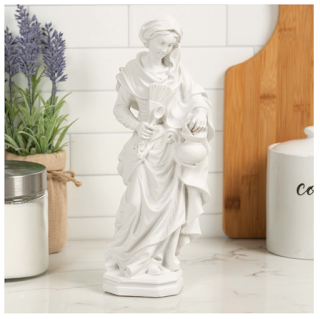
It suggests that when you make dinner, or clean up a messy kitchen the Blessed Mother can empathize with you. While she reigns as Queen in heaven, on earth, she lived the life of a humble housewife. cooking countless meals for Jesus and Joseph, scrubbed countless dishes, washed countless floors, and did countless loads of laundry.
The Catholic Company Kitchen Madonna
It says that Our Lady, The Kitchen Madonna knows the stress and weariness of everyday tasks, means she can help you find new purpose and energy for everything you.
• The key represents 1) the safety of the home against worldly dangers and 2) prayer, which opens Heaven’s door
• The kettle symbolizes the nourishment of both body and soul
• The broom represents the cleanliness of our earthly and spiritual lives
Whether you have a Kitchen Madonna or Gospel music in the background, this is sure to help with the anxiety caused by current events.
As St, Thomas Aquinas said: "To one who has faith, no explanation is necessary. To one without faith, no explanation is possible." So, whether at work or in the kitchen: Pray for people in Ukraine , Pray for people in Russia, Pray to Blessed Mother Mary: - today's scriptures are apropos Jas 5:13-20
The fervent prayer of a righteous person is very powerful.
Elijah was a man like us;
yet he prayed earnestly that it might not rain,
and for three years and six months it did not rain upon the land.
Rancho Santa Margarita, CA – Bonnie and Clyde come to Saddleback college on April 10-19 in the McKinney Theatre.
With Music by Frank Wildhorn, Lyrics by Don Black, and Book by Ivan Menchell, this gritty American biographical crime film has been transformed into an edgy musical. Songs include: This World Will Remember Me, You’re Goin’ Back to Jail, You Can Do Better Than Him, Raise A Little Hell, The Bank, This World Will Remember Us, The Shootout, and Dyin’ Ain’t So Bad.
Directed by Trevor Biship, this thrilling and sexy musical has a non-traditional score combining blues, gospel, and rockabilly music. Another interesting aspect to the musical is the work of set designer Kaitlyn Pietras, an LA-based scenic and projection designer who is dedicated to exploiting and merging the mediums of theatre, architecture, and film into her work. Don’t miss this fearless, shameless, and electrifying story of love, adventure, and crime that captured the excited attention of the entire country. Now, the most notorious couple of the twentieth century takes on a whole new adventure: the stage.
Director Trevor Biship stated, “Set Designer Kaitlyn Pietras and I were inspired by images of the people, homes, and open roads and wastelands taken during the Dust Bowl, images, by Dorothea Lange and other photographers that were so evocative"
The Department of Theatre Arts program at Saddleback College produces several fully-staged shows each year. All students are given the opportunity to audition for every production yet Theatre Arts students are given priority in the casting process. In addition there are numerous opportunities for students to contribute in backstage activities through the Entertainment and Theater Technology program.
Saddleback College is located at 28000 Marguerite Pkwy in Mission Viejo, just east of Interstate 5 at the Avery Parkway exit. Free parking is available in Lot 12. Take Avery Parkway to Marguerite Parkway turn left to the third traffic light, which is Saddleback’s Marguerite entrance. Turn right into the campus and take the third left to Theatre Circle, turning right into Lot 12.
Located in Mission Viejo, Saddleback College provides quality higher education and training to the greater south Orange County community. Having served more than 500,000 students since 1968, Saddleback College offers over 300 degree and certificate programs to help students reach their personal, career, and educational goals. For more information, please visitwww.saddleback.eduand for Fine Arts information, please visit www.saddleback.edu/arts.
Camas, WA - Today is the second days since Ocean Blue unexpectedly went to Bird Heaven, and we can all feel it, specially her mate, Sunny Jewel. It is too quiet, even though we usually have background music.
Sunny Jewel is always energetic and "working" on the pine bark platforms, but for the last couple of days, she seems uninterested, almost lethargic . She hangs around the perch with the large mirror Ocean used to spend a great deal of time. Sunny's body language is also telling - Instead of standing up, she seems to slouch - something I had not noticed before.
Ocean Blue and Sunny Jewel as seen my my grandaughters
There were a couple of times during the day, today, when Sunny would be jumping around in circles, which I could only translate as a feeling of desperation or frustration.
Early today, we switched our usual gospel background music to parakeet sounds. My wife observed that perhaps that was not a good idea, as it could remind Sunny of Ocean's departure - we switched back
During the day, Sunny visited the platform. But I can tell she is in no mood to work. In cleaning the cage, it was obvious that there wasn't as much trash as when Ocean was alive, almost no cleaning required. Most likely, Sunny is not eating much. The branch of Millet is still hanging, almost untouched, until later on today, when Sunny took a few bites,
Sunny Before and After Ocean's Death
In trying to digest Ocean's short life, it is appears that PetSmart has some explaining to do: Ocean was playing all day long Friday, but died on her sleep and we only had her and Sunny for five months! Was it a heart attack? Is it genetic? Is it a breeding problem.
We just hope that Sunny's grieving period is short and that she goes back to being her energetic non-stop self.
Diet: romaine lettuce
Carrots
Millet
Cabbage
Tomatoes
Bananas
They like to make square perches round, and some round perches, really small.
The two brothers were born in Thessalonica, in the Byzantine province, in Greece. According to the Vita Cyrilli ("The Life of Cyril"), Cyril was the youngest of seven brothers; he was born Constantine, but was given the name Cyril upon becoming a monk in Rome shortly before his death. Methodius was born Michael and was given the name Methodius upon becoming a monk in Polychron Monastery at Mysian Olympus (present-day Uludağ in northwest Turkey). Their father was Leo, a droungarios of the Byzantine theme of Thessalonica, and their mother's name was Maria.
The two brothers lost their father when Cyril was fourteen, and the powerful minister Theoktistos, who was logothetes tou dromou, one of the chief ministers of the Empire, became their protector. He was also responsible, along with the regent Bardas, for initiating a far-reaching educational program within the Empire which culminated in the establishment of the University of Magnaura, where Cyril was to teach. Cyril was ordained as priest some time after his education, while his brother Methodius remained a deacon until 867/868.
The administrator and the scholar
History recounts that at first they were apart. The elder brother quickly distinguished himself as a capable administrator, becoming a public official in a province of the Byzantine Empire. The younger brother received a refined education in Constantinople- grammar, rhetoric, astronomy and music – meant to prepare him to be a high-level imperial functionary. But when he was finally offered such a position, Cyril refused it.
A new alphabet for the Bible
When Cyril was about 35, Emperor Michael III thought of him when the Khazars (in today’s Crimea) asked for a learned man who could debate with both Jews and Saracens. At that point the two brothers reunited, setting out on the first of numerous missions together. Two years later, in 863, they were asked to head to Greater Moldavia. The prince of that area had asked for missionaries who could counter the Germanic influence by speaking Slavic, but Cyril and Methodius went far beyond this. Probably realizing how difficult it was to communicate Sacred Scripture to the Slavic tribes in Latin and Greek, the official languages, the brothers – tradition has it, after prayer and fasting – invented a new alphabet, the “Glagolitic” alphabet, more commonly known as Cyrillic: 40 characters derived largely from medieval Greek cursive.
A Gospel for the East
Their work was so extraordinary that the Pope, who called them to Rome, set out in procession to welcome them. The great difficulties of their mission had damaged the health of the younger brother. On February 14, 869, Cyril, who had become a monk, died of an illness. Methodius was consecrated a bishop and continued their mission, overcoming hostility and incomprehension, and teaching his disciples how to translate the sacred texts. Bishop Methodius spent the next fourteen years evangelizing the people in their native language, forming clergy, and effectively administering the Church. He continued to endure harsh treatment from the Germanic clergy, even being imprisoned by them for a time, but he pressed on, extending his missionary work beyond the borders of Great Moravia.
A millennia later, the brothers received the universal honor they deserved when the Western Church added them to its liturgical calendar. A century after that, Pope John Paul II, a Slav himself, honored Cyril and Methodius with the title of co-patrons of Europe and Apostles to the Slavs.
Saints Cyril and Methodius, you gave your lives God’s service with zeal, creativity, and determination. Please pray for me, that God may use me to bring the Good News to people in ways to which they can relate. Saints Cyril and Methodius, pray for me. Jesus, I trust in You.
While some may find praying the Rosary to be monotonous or boring due to the repetitive nature of the prayers, this can be a misconception. The key to a meaningful Rosary prayer is meditation on the mysteries, which are key events in the lives of Jesus and Mary.
The Rosary is not just a boring prayer because it is:
A break from constant stimulation: The structured nature of the Rosary can offer a peaceful reprieve from the distractions of daily life.
Focus on the Gospel: The Rosary is deeply rooted in Scripture and provides a way to meditate on the life, death, and resurrection of Jesus Christ.
Encourages virtue and spiritual growth: By reflecting on the examples of Jesus and Mary, you are encouraged to grow in holiness and resist temptation.
Promotes peace and reduces stress: The rhythm of the prayers and meditation on the mysteries can lead to a sense of calm and peace.
Powerful tool for intercessory prayer: The Rosary allows you to bring the needs of others before God through Mary's intercession.
There are several ways to make praying the Rosary more engaging by choosing the way more suitable to the individual;
Meditate on the mysteries: Don't just recite the prayers; reflect on the events described in each mystery. Use your imagination: Visualize the scenes of the mysteries and imagine yourself present.
Read relevant scripture: Connect the mysteries with corresponding Bible passages.
Use images: Look at pictures or paintings related to the mysteries to help focus your mind.
Some of the Divine Art discussed by Fr Mark-Mary
Pray with intention: Offer each decade for a specific person or need. Pray it out loud: This can help maintain focus.
Consider listening to a guided Rosary: Podcasts, CDs, or YouTube videos can assist with meditation.
Be patient and persistent: It takes time to develop a deeper connection with the Rosary.
The Rosary is a powerful prayer and devotional tool, designed to draw us closer to Jesus through the intercession of His mother, Mary. If you find it challenging to connect with, try implementing some of these strategies and see if it helps you to unlock the rich spiritual benefits of this prayer.
Father Mark-Mary in his Rosary in a Year Podcast has been using a number of the aforementioned techniques. The one I have ground to be more insightful, inspirational and engaging, is through the use of sacred art presented from the perspective of a sacred art critic and or historian. Episode Day 180 is a perfect example.
Art Styles
There are countless art styles and movements throughout history and across cultures.
Beyond the Baroque period and the chiaroscuro technique (which is a technique, not a style itself, according to Wikipedia),
Renaissance: Emphasized humanism, individualism, and a renewed interest in classical art and culture. Artists like Leonardo da Vinci and Raphael mastered techniques like linear perspective and sfumato (subtle blending of colors and tones).
Mannerism: A transitional style that followed the High Renaissance, characterized by elongated forms, artificiality, and dramatic effects
Styles that came before Baroque:Renaissance: Emphasized humanism, individualism, and a renewed interest in classical art and culture. Artists like Leonardo da Vinci and Raphael mastered techniques like linear perspective and sfumato (subtle blending of colors and tones). Mannerism: A transitional style that followed the High Renaissance, characterized by elongated forms, artificiality, and dramatic effects.
Styles that came after Baroque:Rococo: Emerged in the 18th century as a lighter, more decorative, and asymmetrical reaction to Baroque's grandeur. Rococo art focused on themes of romance, leisure, and aristocratic life. Neoclassicism: Inspired by classical antiquity, emphasizing order, balance, and reason. Romanticism: Stressed emotion, individualism, and dramatic themes, often drawing inspiration from nature and the sublime. Impressionism: Characterized by visible brushstrokes, emphasis on light, and capturing the fleeting moments of everyday life. Post-Impressionism: A diverse group of styles that built upon Impressionism, including artists like Van Gogh and Cézanne, who explored form, color, and emotional expression. Modernism: A broad movement encompassing various styles like Cubism, Surrealism, and Abstract Expressionism, focusing on experimentation, innovation, and breaking away from traditional artistic conventions Other Styles and Movements:Arts and Crafts: A movement that emphasized traditional craftsmanship and simple forms, reacting against industrialization. Gothic: A medieval art style characterized by pointed arches, ribbed vaults, and stained glass windows, often associated with cathedrals. Brutalist: A 20th-century architectural style known for its raw, exposed concrete structures. Naturalism: Aims to depict subjects realistically, focusing on accurate representation and detail. This is just a small sampling, and there are many more art styles and movements to explore, each with its own unique characteristics and contributions to art history.
4 Common Art Genres: Realism. Surrealism. Impressionism. Post-Impressionism.
Four Important Eras that Define Art The Artisan Era: prehistory to the 18th century. The Romantic Era: the 18th-20th centuries. The Modern Era: 1900s-1970s. The Contemporary Era: 1970s-present.
Seven Major Forms of Art Painting. Sculpture. Architecture. Literature. Cinema. Theatre. Music.
Iconography vs art
Art is the broader term encompassing all forms of creative expression, while iconography specifically focuses on the study and interpretation of symbols and images within art. Iconography helps us understand the meaning and cultural context of artworks by analyzing the specific symbols, motifs, and visual language employed by the artist.
Art: Encompasses a wide range of creative works, including painting, sculpture, music, literature, and more.
Can be created for various purposes, including aesthetic appreciation, storytelling, social commentary, or religious purposes.
The meaning of a piece of art can be subjective and open to interpretation.
Iconography: A specific field within art history that focuses on the study of symbols and their meanings in art.
Helps to identify and interpret the visual language used by artists to convey specific ideas, stories, or beliefs.
Involves analyzing the symbols, motifs, and compositional elements of an artwork to understand its cultural, historical, and religious context.
For example, in Christian art, the lamb might be an iconographic symbol of Christ, while a dove could represent the Holy
Saint Pius X, a model of so many of the saintly virtues such as piety, charity, deep humility, pastoral zeal, and simplicity remained a country priest at heart throughout his life, faced the problems and evils of a strife-torn world with the spiritual fervor of a crusader.
The inscription on his tomb in the crypt of the basilica of St. Peter's gives the most eloquent testimony to a life spent in the service of God:
"Born poor and humble of heart, Undaunted champion of the Catholic faith, Zealous to restore all things in Christ, Crowned a holy life with a holy death."
Ever mindful of his humble origin, Pope Pius stated, “I was born poor, I lived poor, I will die poor.” He was embarrassed by some of the pomp of the papal court. “Look how they have dressed me up,” he said in tears to an old friend. To another, “It is a penance to be forced to accept all these practices. They lead me around surrounded by soldiers like Jesus when he was seized in Gethsemani.”
Interested in politics, Pope Pius encouraged Italian Catholics to become more politically involved. One of his first papal acts was to end the supposed right of governments to interfere by veto in papal elections—a practice that reduced Interested in politics, Pope Pius encouraged Italian Catholics to become more politically involved. One of his first papal acts was to end the supposed right of governments to interfere by freedom of the 1903 conclave which had elected him.
In 1905, when France renounced its agreement with the Holy See and threatened confiscation of Church property if governmental control of Church affairs were not granted, Pius X courageously rejected the demand.
While he did not author a famous social encyclical as his predecessor had done, he denounced the ill treatment of indigenous peoples on the plantations of Peru, sent a relief commission to Messina after an earthquake, and sheltered refugees at his own expense.
On the 11th anniversary of his election as pope, Europe was plunged into World War I. Pius had foreseen it, but it killed him. “This is the last affliction the Lord will visit on me. I would gladly give my life to save my poor children from this ghastly scourge.” He died a few weeks after the war began, and was canonized in 1954.
St. Pius X was born Giuseppe Melchiorre Sarto on June 2, 1835 in the little Italian town of Riese, in the province of Treviso near Venice. His father was Giovanni Sarto, a cobbler by trade, who was also caretaker of the city hall and the town's postmaster; his mother was Margherita Sanson, a seamstress. The family had few worldly goods and the early life of young Giuseppe, eldest of eight surviving children, was a difficult one. He attended the parish school and while there, his intelligence and high moral character attracted the notice of the pastor, who arranged a scholarship for the lad at the high school in Castelfranco, a larger town two miles from Riese. After completing the course of instruction at Castelfranco, he made known that he had felt the call to the priesthood for some time, but had considered the means of attaining this end beyond his grasp. However, his parents saw that the will of God was in their son's calling, and they did all in their power to encourage him, while the pastor again came to the rescue by arranging another scholarship to the seminary at Padua. In November of 1850, young Sarto arrived at Padua and was immediately taken up with the life and studies of the seminary. The same high qualifications of intellect and spirit, later to blossom forth in his work as bishop and Pope, were much in evidence as a seminarian. Giuseppe worked hard and finally on September 18, 1858, Father Sarto was ordained at the cathedral in Castelfranco.
The young priest's first assignment was as curate at Tombolo, a parish of 1500 souls in the Trentino district of Italy. Here, for eight years, Father Sarto labored among his favorite parishioners, the poor. He also organized a night school for the general education of adults, and trained the parish choir to a high degree of skill in Gregorian Chant. His pastor at Tombolo, Father Constantini, recognizing the worth of the young priest, wrote a prophetic summary of his assistant. "They have sent me as curate a young priest, with orders to mould him to the duties of pastor; in fact, however, the contrary is true. He is so zealous, so full of good sense, and other precious gifts that it is I who can learn much from him. Some day or other he will wear the mitre, of that I am sure. After that—who knows?"
In July of 1867, Father Sarto, then 32 years of age, was appointed pastor of Salzano, one of the most favored parishes in the diocese of Treviso. Soon his concern and help toward the poor became well known throughout the parish, and his two sisters, who acted as his housekeepers, were often at wit's end as their brother gave away much of his own clothing and food to the needy. The new pastor arranged for the instruction of young and old in the fundamentals of Christian Doctrine. The firm conviction that devotion meant little if its meaning was not understood was later to be embodied in the encyclical <Acerbo nimis>, "On the Teaching of Christian Doctrine." After nine years at Salzano, Father Sarto was rewarded for his labors by the appointment as Canon of the Cathedral at Treviso and as Chancellor of that diocese. In addition, he became Spiritual Director of the seminary. Canon Sarto took a deep interest in this work of forming Christ in the hearts of young priests. However, in spite of these many duties, he remained ever the teacher; he often journeyed from the seminary into the city to teach catechism to the children, and he organized Sunday classes for those children who attended public schools, where religion was banned. When the diocese of Mantua fell vacant in 1884, Pope Leo XIII named Canon Sarto as bishop of that diocese.
Bishop Sarto found a troubled diocese in which to begin his labors. There was a general opposition of the government to religion manifested in many ways—monasteries had been suppressed, many religious institutions were government-managed, and Church property was heavily taxed. All these political disturbances had a far-reaching effect on both the clergy and the laiety. The seminaries of Mantua were depleted and a general laxity among the younger priests was evident; dangerous errors of thought had crept into the clergy, and the faults of the shepherds had spread to the flock. In general, a pall of religious indifference and secularism had spread over the diocese. With characteristic energy and spiritual strength, Bishop Sarto set to work to put his see in order. He gave first attention to the seminary, where by his own example of zeal and teaching, he won back the clergy to full and faithful service. The laxity of the people was attributed to neglect of parish priests in the instruction of the catechism; Bishop Sarto often taught such classes himself, and in his pastoral visits and letters, he urged the establishment of the Confraternity of Christian Doctrine in all parishes. God blessed this work on behalf of all classes of His flock, and in 1893, His Holiness, Leo XIII, elevated Bishop Sarto to Cardinal and appointed him Patriarch of Venice.
As Patriarch of Venice, it was Tombolo, Salzano, and Mantua all over again, but on a widening scale—the same care for his clergy and for the seminaries, the ever-willing hand and heart given to the poor, the long hours spent in teaching young and old—only the red of his new office had replaced the purple and black of former days. Social and economic problems were of prime concern to the new cardinal, and any worthy social action organization was assured of his help. When the Workingmen's Society was founded in Venice, the name of Cardinal Sarto was at the top of the list and he paid regular dues as a member! Once it seemed that an important diocesan newspaper would go into bankruptcy, and the cardinal declared, "I would rather sell my crozier and my robes of office than let that paper go under."
On July 20, 1903, the reign of Leo XIII came to a close, and the world mourned the death of a great Pontiff. Cardinals from all over the world came to Rome for the conclave which would elect the new Pope, and it is again typical of Cardinal Sarto that, due to his many charities, he was short of funds necessary to make the trip; so sure was he that he would never be elected that the problem was solved by the purchase of a return ticket to Venice! With the conclave in solemn session, the voting began, and with each successive ballot, Cardinal Sarto gained more votes. As his cause continued to gain strength, he all the more strongly pleaded that he was neither worthy nor capable enough for the office. When it was finally announced that he had gained sufficient votes to be elected, he bent his head, broke into tears, and whispered, "Fiat voluntas tua" (Thy will be done). He accepted, took the name of Pius X, and on August 9, 1903, was crowned as Vicar of Christ on earth.
The world was now the parish of the new Pontiff, and in his first encyclical he announced the aim of his reign. It was his desire, in the words of St. Paul, "to restore all things in Christ." (Eph 1:10). The prime means of accomplishing this restoration was dearly seen by Pius to be through the clergy, and throughout his reign, the Pope exhorted bishops to reorganize the seminaries and to obtain the best possible training for these men who would instill in others the knowledge of God. The Pontiff published an encyclical, "Exhortation to the Catholic Clergy," in which he pointed out that only through a trained and disciplined clergy could a program of return to Christ be realized.
The religious instruction of young and old became the second most important means toward the Christian restoration, and in his encyclical <Acerbo nimis>, "On the Teaching of Christian Doctrine," Pius X firmly stated his position. The evils of the world were traceable to an ignorance of God, he said, and it was necessary for priests to make the eternal truths available to all and in a language that all could understand. Ever an example, he himself gave Sunday instruction to the people in one of the Vatican courtyards. However, no reform of Pius' was more widely acclaimed than the Decrees on Holy Communion, and Pius X is often called "the Pope of the Eucharist." These decrees, issued from 1905 through 1910, allowed the reception of first Holy Communion at an earlier age than had formerly been required, encouraged the frequent reception of the Holy Eucharist by all Catholics, and relaxed the fast for the sick.
In the field of Christian social action the Pope had always been an ardent champion, and in 1905, he published <Il fermo proposito>, "On Catholic Social Action." In this work, the Pontiff listed practical recommendations for the solution of the social problem; he reaffirmed the need and power of prayer, but said that society would not be Christianized by prayer alone. Action is needed, he pointed out, as had been shown in the lives of the Apostles and of saints like Francis Xavier. The Pope likewise vigorously promoted reforms within the liturgy of the Church, since he felt that these were long overdue. In his <Motu proprio on the Restoration of Church Music>, he listed the aims of such music to be sanctity, beauty of form, and universality. Gregorian Chant, the Pope felt, was the music best suited to attain those aims. However, he felt that an attempt to make all Church music Gregorian was an exaggerated fad, and modern compositions were always welcomed by the Pontiff as long as they fulfilled the prescribed norms. Pius also reformed the Breviary, and was founder of the Biblical Institute for the advancement of scholarship in the study of the Scriptures. Even more important for the internal structure of the Church, he initiated and closely supervised the construction of the Code of Canon Law.
The familiar notion of Pius X as the Teacher of Christian Truth and the firm guide and staunch foe of error was forceably illustrated in 1907 when he issued more than fourteen pronouncements against the growth of Modernism. This subtle philosophy, in which Pius saw the poison of all heresies, pretended to "modernize" the Church and to make it keep pace with the changing times. In reality, its end would have been the destructions of the foundation of faith. The crowning achievement of the Pontiff's writings and pronouncements against this philosophy came in the encyclical, <Pascendi dominici gregis>, "On the Doctrines of the Modernists." In this work, which was a death blow to Modernism, he gave a systematic exposition of the errors involved, their causes, and provisions for combatting the errors by definite preventive measures.
Pius X labored for the Master until the very last days of his life. His 79 years had not set too heavily upon him, but overwork and anxiety over the impending doom of a World War began to take their toll. Pius saw clearly the horrors of the coming conflict and felt helpless that he could not prevent it. A little more than a month after the outbreak of the war, the Pope was seized with an attack of influenza, and his weakened constitution could not combat the illness. The end for the Christ-like Pius came peacefully on August 20, 1914, and the world, though in the throes of a death struggle, paused to mourn the gentle and humble man whose last will and testament gave such an insight into his character. It read, in part, "I was born poor, I lived poor, I die poor." Shortly after his death, the faithful began to make pilgrimages to his tomb, bringing flowers, prayers, and petitions for favors. Accounts of miraculous favors and cures, some even accomplished during his lifetime and granted through his intercession, were announced and given widespread acclaim. In 1923, the Church, always cautious in such matters, began inquiry into the life and virtues of Pius X, and in February of 1943, the first official step in his Cause was taken when the necessary decree was signed by the present Pontiff, Pius XII. In honor of the work which Pius X had accomplished in its behalf, the Confraternity of Christian Doctrine actively contributed in promoting the Cause for his beatification and canonization. On June 3, 1951, Pius X was declared Blessed, and finally on May 29, 1954, amid the traditional pealing of the bells in the great churches of Rome, Giuseppe Sarto, the humble parish priest of the world, was canonized a saint of God.
<Excerpts from> the Encyclical <Il fermo proposito>, On Catholic Action
. . . <Immense is the field of Catholic action>; it excludes absolutely nothing which in any way, directly or indirectly, belongs to the divine mission of the Church.
It is plainly necessary to take part individually in a work so important, not only for the sanctification of our own souls, but also in order to spread and more fully open out the Kingdom of God in individuals, families, and society, each one working according to his strength for his neighbor's good, by the diffusion of revealed truth, the exercise of Christian virtue, and the spiritual and corporal works of charity and mercy. Such is the conduct worthy of God to which St. Paul exhorts us, so as to please Him in all things, bringing forth fruits of all good works, and increasing in the knowledge of God: "That you may walk worthy of God in all things pleasing; being fruitful in every good work, and increasing in the knowledge of God."
Besides these benefits, there are many in the natural order which, without being directly the object of the Church's mission, nevertheless flow from it as one of its natural consequences. Such is the light of Catholic revelation that it vividly illuminates all knowledge; so great is the strength of the Gospel maxims that the precepts of the natural law find in them a surer basis and a more energetic vigor; such, in fine, is the power of the truth and morality taught by Jesus Christ that even the material well-being of individuals, of the family, and of human society, receive from them support and protection.
The Church, while preaching Jesus crucified, who was a stumbling-block and folly to the world, has been the first inspirer and promoter of civilization. She had spread it whenever her apostles have preached, preserving and perfecting what was good in ancient pagan civilization, rescuing from barbarism and raising to a form of civilized society the new peoples who took refuge in her maternal bosom, and giving to the whole of human society, little by little, no doubt, but with a sure and ever onward march, that characteristic stamp which it still everywhere preserves. The civilization of the world is Christian civilization; the more frankly Christian it is, so much is it more true, more lasting, and more productive of precious fruit; the more it withdraws from the Christian ideal, so much the feebler is it, to the great detriment of society....
. . . <To restore all things in Christ> has ever been the Church's motto, and it is specially Ours, in the perilous times in which we live. To restore all things, not in any fashion, but in Christ; "that are in heaven, and on earth, in Him," adds the Apostle; to restore in Christ not only what depends on the divine mission of the Church to conduct souls to God, but also, as We have explained, that which flows spontaneously from this divine mission, namely, Christian civilization in each and every one of the elements which compose it.
To dwell only on this last part of the restoration, you see well what support is given to the Church by those chosen bands of Catholics whose aim is to unite all their forces in order to combat anti-Christian civilization by every just and lawful means, and to repair in every way the grievous disorders which flow from it; to reinstate Jesus Christ in the family, the school, and society; to re-establish the principle that human authority represents that of God; to take intimately to heart the interests of the people, especially those of the working and agricultural classes, not only by the inculcation of religion, the only true source of comfort in the sorrows of life, but also by striving to dry their tears, to soothe their sufferings, and by wise measures to improve their economic condition; to endeavor, consequently, to make public laws conformable to justice, to amend or suppress those which are not so; finally, with a true Catholic spirit, to defend and support the rights of God in everything, and the no less sacred laws of the Church.
All these works, of which Catholic laymen are the principal supporters and promoters, and whose form varies according to the special needs of each nation, and the particular circumstances of each country, constitute what is generally known by a distinctive, and surely a very noble name: <Catholic Action> or <Action of Catholics>....
(trans. in <Publications of the Catholic Truth Society>, vol. 83, London, 1910.)
<Excerpts from> the Encyclical Letter <Acerbo nimis>, On the teaching of Christian Doctrine
. . . <How many and how grave are the consequences of ignorance in matters of religion>! And on the other hand, how necessary and how beneficial is religious instruction! It is indeed vain to expect the fulfillment of the duties of a Christian by one who does not even know them.
We must now consider upon whom rests the obligation to dissipate this most pernicious ignorance and to impart in its stead the knowledge that is wholly indispensable. There can be no doubt, Venerable Brothers, that this most important duty rests upon all those who are pastors of souls. On them, by command of Christ, rest the obligations of knowing and of feeding the flocks committed to their care; and to feed implies, first of all, to teach. "I will give you pastors after my own heart," God promised through Jeremias, "and they shall feed you with knowledge and doctrine." Hence the Apostle Paul said: "Christ did not send me to baptize, but to preach the Gospel," thereby indicating that the first duty of all those who are entrusted in any way with the government of the Church is to instruct the faithful in the things of God....
. . . Here then it is well to emphasize and insist that for a priest there is no duty more grave or obligation more binding than this. Who, indeed, will deny that knowledge should be joined to holiness of life in the priest? "For the lips of the priest shall keep knowledge." The Church demands this knowledge of those who are to be ordained to the priesthood. Why? Because the Christian people expect from them knowledge of the divine law, and it was for that end that they were sent by God. "And they shall seek the law at his mouth; because He is the messenger of the Lord of Hosts." Thus the bishop speaking to the candidates for the priesthood in the ordination ceremony says: "Let your teaching be a spiritual remedy for God's people; may they be worthy fellow workers of our order; and thus meditating day and night on His law, they may believe what they read, and teach what they shall believe.". . .
. . . In order to enkindle the zeal of the ministers of God, We again insist on the need to reach the ever-increasing number of those who know nothing at all of religion, or who possess at most such knowledge of God and Christian truths as befits idolaters. How many there are, alas, not only among the young, but among adults and those advanced in years, who know nothing of the chief mysteries of faith; who on hearing the name of Christ can only ask: "Who is He . . . that I may believe in Him?" In consequence of this ignorance, they do not consider it a crime to excite and nourish hatred against their neighbor, to enter into most unjust contracts, to do business in dishonest fashion, to hold the funds of others at an exhorbitant interest rate, and to commit other iniquities not less reprehensible. They are, moreover, ignorant of the law of Christ which not only condemns immoral actions, but also forbids deliberate immoral thoughts and desires. Even when for some reason or other they avoid sensual pleasures, they nevertheless entertain evil thoughts without the least scruple, thereby multiplying their sins above the number of hairs of the head. These persons are found, we deem it necessary to repeat, not merely among the poorer classes of the people or in sparsely settled districts, but also among those in the higher walks of life, even, indeed, among those puffed up with learning, who, relying upon a vain erudition, feel free to ridicule religion . . .
. . . What We have said so far demonstrates the supreme importance of religious instruction. We ought, therefore, to do all that lies in our power to maintain the teaching of Christian doctrine with full vigor, and where such is neglected, to restore it; for in the words of Our predecessor, Benedict XIV, "There is nothing more effective than catechetical instruction to spread the glory of God and to secure the salvation of souls."
(trans. by J. B. Collins in Catechetical Documents of Pope Pius X, Paterson, N. J., 1946.)
Saint Pius X, Pope. Scriptural Saint. Celebration of Feast Day is August 21.
Taken from "Lives of Saints", Published by John J. Crawley & Co., Inc.
The second of 10 children in a poor Italian family, Joseph Sarto became Pius X at age 68. He was one of the 20th century’s greatest popes.
St. Pius X was born Giuseppe Melchiorre Sarto on June 2, 1835 in the little Italian town of Riese, in the province of Treviso near Venice. His father was Giovanni Sarto, a cobbler by trade, who was also caretaker of the city hall and the town's postmaster; his mother was Margherita Sanson, a seamstress. The family had few worldly goods and the early life of young Giuseppe, eldest of eight surviving children, was a difficult one. He attended the parish school and while there, his intelligence and high moral character attracted the notice of the pastor, who arranged a scholarship for the lad at the high school in Castelfranco, a larger town two miles from Riese. After completing the course of instruction at Castelfranco, he made known that he had felt the call to the priesthood for some time, but had considered the means of attaining this end beyond his grasp. However, his parents saw that the will of God was in their son's calling, and they did all in their power to encourage him, while the pastor again came to the rescue by arranging another scholarship to the seminary at Padua. In November of 1850, young Sarto arrived at Padua and was immediately taken up with the life and studies of the seminary. The same high qualifications of intellect and spirit, later to blossom forth in his work as bishop and Pope, were much in evidence as a seminarian. Giuseppe worked hard and finally on September 18, 1858, Father Sarto was ordained at the cathedral in Castelfranco.
Ever mindful of his humble origin, Pope Pius stated, “I was born poor, I lived poor, I will die poor.” He was embarrassed by some of the pomp of the papal court. “Look how they have dressed me up,” he said in tears to an old friend. To another, “It is a penance to be forced to accept all these practices. They lead me around surrounded by soldiers like Jesus when he was seized in Gethsemani.”
Interested in politics, Pope Pius encouraged Italian Catholics to become more politically involved. One of his first papal acts was to end the supposed right of governments to interfere by veto in papal elections—a practice that reduced the freedom of the 1903 conclave which had elected him
In 1905, when France renounced its agreement with the Holy See and threatened confiscation of Church property if governmental control of Church affairs were not granted, Pius X courageously rejected the demand.
While he did not author a famous social encyclical as his predecessor had done, he denounced the ill treatment of indigenous peoples on the plantations of Peru, sent a relief commission to Messina after an earthquake, and sheltered refugees at his own expense
On the 11th anniversary of his election as pope, Europe was plunged into World War I. Pius had foreseen it, but it killed him. “This is the last affliction the Lord will visit on me. I would gladly give my life to save my poor children from this ghastly scourge.” He died a few weeks after the war began, and was canonized in 1954.
The young priest's first assignment was as curate at Tombolo, a parish of 1500 souls in the Trentino district of Italy. Here, for eight years, Father Sarto labored among his favorite parishioners, the poor. He also organized a night school for the general education of adults, and trained the parish choir to a high degree of skill in Gregorian Chant. His pastor at Tombolo, Father Constantini, recognizing the worth of the young priest, wrote a prophetic summary of his assistant. "They have sent me as curate a young priest, with orders to mould him to the duties of pastor; in fact, however, the contrary is true. He is so zealous, so full of good sense, and other precious gifts that it is I who can learn much from him. Some day or other he will wear the mitre, of that I am sure. After that—who knows?"
In July of 1867, Father Sarto, then 32 years of age, was appointed pastor of Salzano, one of the most favored parishes in the diocese of Treviso. Soon his concern and help toward the poor became well known throughout the parish, and his two sisters, who acted as his housekeepers, were often at wit's end as their brother gave away much of his own clothing and food to the needy. The new pastor arranged for the instruction of young and old in the fundamentals of Christian Doctrine. The firm conviction that devotion meant little if its meaning was not understood was later to be embodied in the encyclical <Acerbo nimis>, "On the Teaching of Christian Doctrine." After nine years at Salzano, Father Sarto was rewarded for his labors by the appointment as Canon of the Cathedral at Treviso and as Chancellor of that diocese. In addition, he became Spiritual Director of the seminary. Canon Sarto took a deep interest in this work of forming Christ in the hearts of young priests. However, in spite of these many duties, he remained ever the teacher; he often journeyed from the seminary into the city to teach catechism to the children, and he organized Sunday classes for those children who attended public schools, where religion was banned. When the diocese of Mantua fell vacant in 1884, Pope Leo XIII named Canon Sarto as bishop of that diocese.
Bishop Sarto found a troubled diocese in which to begin his labors. There was a general opposition of the government to religion manifested in many ways—monasteries had been suppressed, many religious institutions were government-managed, and Church property was heavily taxed. All these political disturbances had a far-reaching effect on both the clergy and the laiety. The seminaries of Mantua were depleted and a general laxity among the younger priests was evident; dangerous errors of thought had crept into the clergy, and the faults of the shepherds had spread to the flock. In general, a pall of religious indifference and secularism had spread over the diocese. With characteristic energy and spiritual strength, Bishop Sarto set to work to put his see in order. He gave first attention to the seminary, where by his own example of zeal and teaching, he won back the clergy to full and faithful service. The laxity of the people was attributed to neglect of parish priests in the instruction of the catechism; Bishop Sarto often taught such classes himself, and in his pastoral visits and letters, he urged the establishment of the Confraternity of Christian Doctrine in all parishes. God blessed this work on behalf of all classes of His flock, and in 1893, His Holiness, Leo XIII, elevated Bishop Sarto to Cardinal and appointed him Patriarch of Venice.
As Patriarch of Venice, it was Tombolo, Salzano, and Mantua all over again, but on a widening scale—the same care for his clergy and for the seminaries, the ever-willing hand and heart given to the poor, the long hours spent in teaching young and old—only the red of his new office had replaced the purple and black of former days. Social and economic problems were of prime concern to the new cardinal, and any worthy social action organization was assured of his help. When the Workingmen's Society was founded in Venice, the name of Cardinal Sarto was at the top of the list and he paid regular dues as a member! Once it seemed that an important diocesan newspaper would go into bankruptcy, and the cardinal declared, "I would rather sell my crozier and my robes of office than let that paper go under."
On July 20, 1903, the reign of Leo XIII came to a close, and the world mourned the death of a great Pontiff. Cardinals from all over the world came to Rome for the conclave which would elect the new Pope, and it is again typical of Cardinal Sarto that, due to his many charities, he was short of funds necessary to make the trip; so sure was he that he would never be elected that the problem was solved by the purchase of a return ticket to Venice! With the conclave in solemn session, the voting began, and with each successive ballot, Cardinal Sarto gained more votes. As his cause continued to gain strength, he all the more strongly pleaded that he was neither worthy nor capable enough for the office. When it was finally announced that he had gained sufficient votes to be elected, he bent his head, broke into tears, and whispered, "Fiat voluntas tua" (Thy will be done). He accepted, took the name of Pius X, and on August 9, 1903, was crowned as Vicar of Christ on earth.
The world was now the parish of the new Pontiff, and in his first encyclical he announced the aim of his reign. It was his desire, in the words of St. Paul, "to restore all things in Christ." (Eph 1:10). The prime means of accomplishing this restoration was dearly seen by Pius to be through the clergy, and throughout his reign, the Pope exhorted bishops to reorganize the seminaries and to obtain the best possible training for these men who would instill in others the knowledge of God. The Pontiff published an encyclical, "Exhortation to the Catholic Clergy," in which he pointed out that only through a trained and disciplined clergy could a program of return to Christ be realized.
The religious instruction of young and old became the second most important means toward the Christian restoration, and in his encyclical <Acerbo nimis>, "On the Teaching of Christian Doctrine," Pius X firmly stated his position. The evils of the world were traceable to an ignorance of God, he said, and it was necessary for priests to make the eternal truths available to all and in a language that all could understand. Ever an example, he himself gave Sunday instruction to the people in one of the Vatican courtyards. However, no reform of Pius' was more widely acclaimed than the Decrees on Holy Communion, and Pius X is often called "the Pope of the Eucharist." These decrees, issued from 1905 through 1910, allowed the reception of first Holy Communion at an earlier age than had formerly been required, encouraged the frequent reception of the Holy Eucharist by all Catholics, and relaxed the fast for the sick.
In the field of Christian social action the Pope had always been an ardent champion, and in 1905, he published <Il fermo proposito>, "On Catholic Social Action." In this work, the Pontiff listed practical recommendations for the solution of the social problem; he reaffirmed the need and power of prayer, but said that society would not be Christianized by prayer alone. Action is needed, he pointed out, as had been shown in the lives of the Apostles and of saints like Francis Xavier. The Pope likewise vigorously promoted reforms within the liturgy of the Church, since he felt that these were long overdue. In his <Motu proprio on the Restoration of Church Music>, he listed the aims of such music to be sanctity, beauty of form, and universality. Gregorian Chant, the Pope felt, was the music best suited to attain those aims. However, he felt that an attempt to make all Church music Gregorian was an exaggerated fad, and modern compositions were always welcomed by the Pontiff as long as they fulfilled the prescribed norms. Pius also reformed the Breviary, and was founder of the Biblical Institute for the advancement of scholarship in the study of the Scriptures. Even more important for the internal structure of the Church, he initiated and closely supervised the construction of the Code of Canon Law.
The familiar notion of Pius X as the Teacher of Christian Truth and the firm guide and staunch foe of error was forceably illustrated in 1907 when he issued more than fourteen pronouncements against the growth of Modernism. This subtle philosophy, in which Pius saw the poison of all heresies, pretended to "modernize" the Church and to make it keep pace with the changing times. In reality, its end would have been the destructions of the foundation of faith. The crowning achievement of the Pontiff's writings and pronouncements against this philosophy came in the encyclical, <Pascendi dominici gregis>, "On the Doctrines of the Modernists." In this work, which was a death blow to Modernism, he gave a systematic exposition of the errors involved, their causes, and provisions for combatting the errors by definite preventive measures.
Pius X labored for the Master until the very last days of his life. His 79 years had not set too heavily upon him, but overwork and anxiety over the impending doom of a World War began to take their toll. Pius saw clearly the horrors of the coming conflict and felt helpless that he could not prevent it. A little more than a month after the outbreak of the war, the Pope was seized with an attack of influenza, and his weakened constitution could not combat the illness. The end for the Christ-like Pius came peacefully on August 20, 1914, and the world, though in the throes of a death struggle, paused to mourn the gentle and humble man whose last will and testament gave such an insight into his character. It read, in part, "I was born poor, I lived poor, I die poor." Shortly after his death, the faithful began to make pilgrimages to his tomb, bringing flowers, prayers, and petitions for favors. Accounts of miraculous favors and cures, some even accomplished during his lifetime and granted through his intercession, were announced and given widespread acclaim. In 1923, the Church, always cautious in such matters, began inquiry into the life and virtues of Pius X, and in February of 1943, the first official step in his Cause was taken when the necessary decree was signed by the present Pontiff, Pius XII. In honor of the work which Pius X had accomplished in its behalf, the Confraternity of Christian Doctrine actively contributed in promoting the Cause for his beatification and canonization. On June 3, 1951, Pius X was declared Blessed, and finally on May 29, 1954, amid the traditional pealing of the bells in the great churches of Rome, Giuseppe Sarto, the humble parish priest of the world, was canonized a saint of God.
<Excerpts from> the Encyclical <Il fermo proposito>, On Catholic Action
. . . <Immense is the field of Catholic action>; it excludes absolutely nothing which in any way, directly or indirectly, belongs to the divine mission of the Church.
It is plainly necessary to take part individually in a work so important, not only for the sanctification of our own souls, but also in order to spread and more fully open out the Kingdom of God in individuals, families, and society, each one working according to his strength for his neighbor's good, by the diffusion of revealed truth, the exercise of Christian virtue, and the spiritual and corporal works of charity and mercy. Such is the conduct worthy of God to which St. Paul exhorts us, so as to please Him in all things, bringing forth fruits of all good works, and increasing in the knowledge of God: "That you may walk worthy of God in all things pleasing; being fruitful in every good work, and increasing in the knowledge of God."
Besides these benefits, there are many in the natural order which, without being directly the object of the Church's mission, nevertheless flow from it as one of its natural consequences. Such is the light of Catholic revelation that it vividly illuminates all knowledge; so great is the strength of the Gospel maxims that the precepts of the natural law find in them a surer basis and a more energetic vigor; such, in fine, is the power of the truth and morality taught by Jesus Christ that even the material well-being of individuals, of the family, and of human society, receive from them support and protection.
The Church, while preaching Jesus crucified, who was a stumbling-block and folly to the world, has been the first inspirer and promoter of civilization. She had spread it whenever her apostles have preached, preserving and perfecting what was good in ancient pagan civilization, rescuing from barbarism and raising to a form of civilized society the new peoples who took refuge in her maternal bosom, and giving to the whole of human society, little by little, no doubt, but with a sure and ever onward march, that characteristic stamp which it still everywhere preserves. The civilization of the world is Christian civilization; the more frankly Christian it is, so much is it more true, more lasting, and more productive of precious fruit; the more it withdraws from the Christian ideal, so much the feebler is it, to the great detriment of society....
. . . <To restore all things in Christ> has ever been the Church's motto, and it is specially Ours, in the perilous times in which we live. To restore all things, not in any fashion, but in Christ; "that are in heaven, and on earth, in Him," adds the Apostle; to restore in Christ not only what depends on the divine mission of the Church to conduct souls to God, but also, as We have explained, that which flows spontaneously from this divine mission, namely, Christian civilization in each and every one of the elements which compose it.
To dwell only on this last part of the restoration, you see well what support is given to the Church by those chosen bands of Catholics whose aim is to unite all their forces in order to combat anti-Christian civilization by every just and lawful means, and to repair in every way the grievous disorders which flow from it; to reinstate Jesus Christ in the family, the school, and society; to re-establish the principle that human authority represents that of God; to take intimately to heart the interests of the people, especially those of the working and agricultural classes, not only by the inculcation of religion, the only true source of comfort in the sorrows of life, but also by striving to dry their tears, to soothe their sufferings, and by wise measures to improve their economic condition; to endeavor, consequently, to make public laws conformable to justice, to amend or suppress those which are not so; finally, with a true Catholic spirit, to defend and support the rights of God in everything, and the no less sacred laws of the Church.
All these works, of which Catholic laymen are the principal supporters and promoters, and whose form varies according to the special needs of each nation, and the particular circumstances of each country, constitute what is generally known by a distinctive, and surely a very noble name: <Catholic Action> or <Action of Catholics>....
(trans. in <Publications of the Catholic Truth Society>, vol. 83, London, 1910.)
<Excerpts from> the Encyclical Letter <Acerbo nimis>, On the teaching of Christian Doctrine
. . . <How many and how grave are the consequences of ignorance in matters of religion>! And on the other hand, how necessary and how beneficial is religious instruction! It is indeed vain to expect the fulfillment of the duties of a Christian by one who does not even know them.
We must now consider upon whom rests the obligation to dissipate this most pernicious ignorance and to impart in its stead the knowledge that is wholly indispensable. There can be no doubt, Venerable Brothers, that this most important duty rests upon all those who are pastors of souls. On them, by command of Christ, rest the obligations of knowing and of feeding the flocks committed to their care; and to feed implies, first of all, to teach. "I will give you pastors after my own heart," God promised through Jeremias, "and they shall feed you with knowledge and doctrine." Hence the Apostle Paul said: "Christ did not send me to baptize, but to preach the Gospel," thereby indicating that the first duty of all those who are entrusted in any way with the government of the Church is to instruct the faithful in the things of God....
. . . Here then it is well to emphasize and insist that for a priest there is no duty more grave or obligation more binding than this. Who, indeed, will deny that knowledge should be joined to holiness of life in the priest? "For the lips of the priest shall keep knowledge." The Church demands this knowledge of those who are to be ordained to the priesthood. Why? Because the Christian people expect from them knowledge of the divine law, and it was for that end that they were sent by God. "And they shall seek the law at his mouth; because He is the messenger of the Lord of Hosts." Thus the bishop speaking to the candidates for the priesthood in the ordination ceremony says: "Let your teaching be a spiritual remedy for God's people; may they be worthy fellow workers of our order; and thus meditating day and night on His law, they may believe what they read, and teach what they shall believe.". . .
. . . In order to enkindle the zeal of the ministers of God, We again insist on the need to reach the ever-increasing number of those who know nothing at all of religion, or who possess at most such knowledge of God and Christian truths as befits idolaters. How many there are, alas, not only among the young, but among adults and those advanced in years, who know nothing of the chief mysteries of faith; who on hearing the name of Christ can only ask: "Who is He . . . that I may believe in Him?" In consequence of this ignorance, they do not consider it a crime to excite and nourish hatred against their neighbor, to enter into most unjust contracts, to do business in dishonest fashion, to hold the funds of others at an exhorbitant interest rate, and to commit other iniquities not less reprehensible. They are, moreover, ignorant of the law of Christ which not only condemns immoral actions, but also forbids deliberate immoral thoughts and desires. Even when for some reason or other they avoid sensual pleasures, they nevertheless entertain evil thoughts without the least scruple, thereby multiplying their sins above the number of hairs of the head. These persons are found, we deem it necessary to repeat, not merely among the poorer classes of the people or in sparsely settled districts, but also among those in the higher walks of life, even, indeed, among those puffed up with learning, who, relying upon a vain erudition, feel free to ridicule religion . . .
(trans. by J. B. Collins in Catechetical Documents of Pope Pius X, Paterson, N. J., 1946.)
Saint Pius X, Pope. Scriptural Saint. Celebration of Feast Day is August 21.
"Lives of Saints", Published by John J. Crawley & Co., Inc.
First written in the mid-eighteenth century, Butler's Lives of the Saints is now available in a four-volume set which was revised in 1956 to include 2,565 saints compared to the original 1,486. After the Bible, the Missal and The Imitation of Christ it is the most popular Catholic book.